
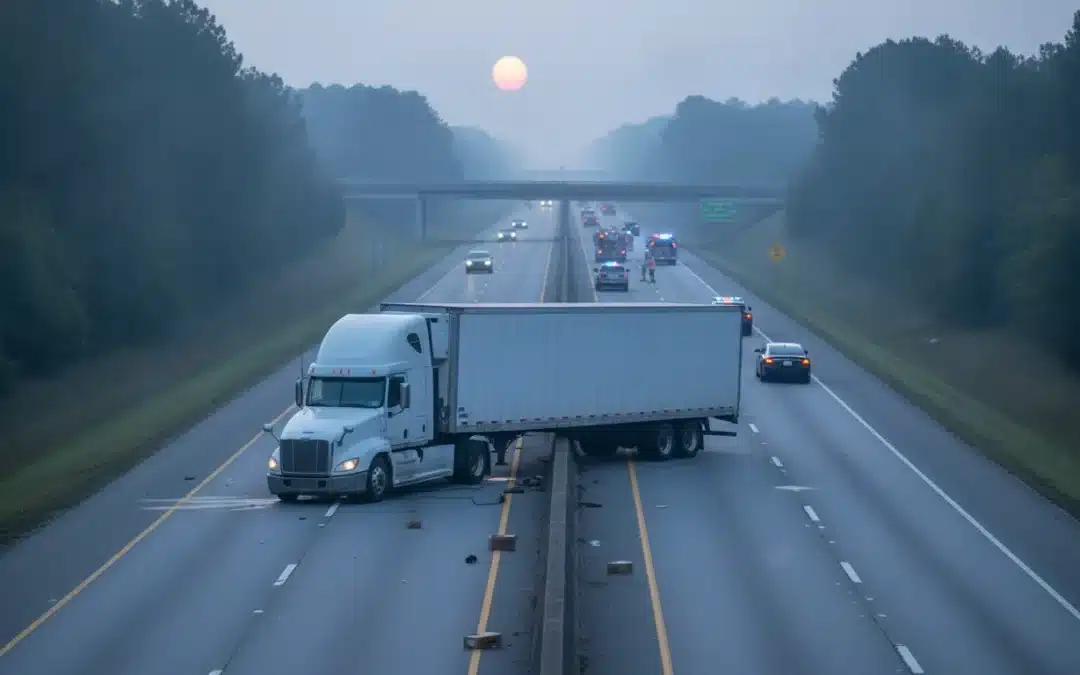
When a tractor and trailer fold sharply at the connection point, the truck can sweep across multiple lanes in seconds. A jackknife crash may leave drivers with little time to react and can create a second collision involving vehicles that were nowhere near the truck when the loss of control began.
If you were injured in a jackknife crash, a jackknife truck accident attorney georgia victims trust can help preserve evidence and investigate how braking, speed, traction, cargo, driver conduct, vehicle maintenance, and company practices contributed. Responsibility is not automatic, and the available evidence may point to more than one party.
For Georgia families, the immediate priorities are safety, medical care, and protecting information that may explain what happened. Understanding the mechanics of a jackknife crash is the first step toward recognizing why these collisions are so dangerous and what a careful claim investigation must examine.
What Is a Jackknife Truck Accident and Why Is It So Dangerous?
A jackknife truck accident happens when a tractor and its trailer lose alignment and fold toward each other, creating an angle that resembles a closing pocketknife. The trailer may swing across neighboring lanes while the tractor continues in another direction. In moments, a truck that was traveling within one lane can become a broad, moving obstruction.
That sudden movement creates several dangers. A trailer crossing lanes can leave nearby drivers little time or room to avoid it. Vehicles may strike the trailer, the tractor, or one another as they brake and swerve. A crash that begins with one truck can therefore become a chain reaction involving multiple cars, motorcycles, and other commercial vehicles. The federal Large Truck Crash Causation Study found that 73 percent of the crashes in its sample involved a large truck colliding with at least one other vehicle. FMCSA’s study provides important context for understanding why truck collisions often affect more than one person.
For people caught in the path of a folding trailer, the consequences can be devastating. A driver may be struck before seeing the hazard, forced into another lane, or trapped in a secondary collision. The size and weight of the equipment can also make the resulting scene especially complex for injured people and their families.
Still, the word jackknife describes the truck’s movement, not the legal conclusion about who caused the crash. A collision may involve driver decisions, vehicle condition, roadway or weather conditions, cargo issues, or the conduct of another road user. FMCSA explains that crash factors can occur immediately before a collision or hours, days, or months earlier, and reconstruction experts rarely attribute a crash to one factor alone. Investigators must examine the available evidence before responsibility can be assessed.
What Causes a Semi-Truck to Jackknife on a Georgia Highway?
A jackknife crash usually develops when the trailer and tractor no longer travel in a controlled line. The trailer can swing outward as the tractor slows, turns, or loses traction. That movement may reflect one mistake, several connected conditions, or a sudden mechanical or roadway problem. FMCSA explains that large-truck crashes can be influenced by events occurring hours, days, or months before the collision, and that reconstruction experts rarely identify a single cause. The FMCSA crash-causation analysis supports looking at the full chain of events rather than assuming fault from the final position of the truck.
Braking, speed, and traction
Hard or uneven braking can cause the tractor to slow faster than the trailer, particularly when the trailer wheels lose grip. Excessive speed can leave less time and distance to respond to stopped traffic, a curve, a lane change, or a roadway obstruction. Wet pavement, standing water, ice, or other conditions can further reduce traction. A driver’s braking decision must be evaluated alongside the truck’s speed, following distance, road surface, traffic, and the condition of the braking system. A jackknife does not automatically prove that the driver was speeding or braking improperly.
Cargo, fatigue, and distraction
Cargo that is overloaded, unevenly distributed, or inadequately secured may shift as the truck brakes or turns. That can change the trailer’s balance and make it harder to control. Federal cargo-securement rules address how commercial cargo must be restrained. Investigators may therefore examine loading records, inspection documents, and the condition of tie-downs or other securement devices rather than relying only on witness impressions. The applicable rules are available through FMCSA’s cargo-securement guidance.
Fatigue or distraction can also affect hazard recognition, reaction time, lane control, and braking. Evidence may include driving schedules, hours-of-service records, dispatch communications, phone activity, and witness accounts. These issues require careful proof and should not be assumed simply because a crash occurred.
Weather and mechanical or coupling problems
FMCSA identifies driver training and experience, vehicle design and manufacture, highway conditions, traffic signaling, and weather as factors that can influence a large-truck crash. A tire blowout or another sudden equipment failure may be an immediate pre-crash event. Mechanical defects involving tires, brakes, steering, suspension, fifth-wheel components, or the trailer connection may also warrant inspection. The responsible party could depend on who owned, maintained, loaded, inspected, or operated the equipment. A thorough investigation considers all contributing conditions before assigning responsibility.
Who May Be Liable in a Georgia Jackknife Truck Crash?
Liability after a jackknife collision depends on what caused the trailer to swing, how each party contributed, and what the evidence shows. The truck’s markings may identify a carrier, but they do not automatically establish that carrier’s legal responsibility. A careful investigation may identify one responsible party or several.
| Potentially relevant party | Questions an investigation may ask |
|---|---|
| Driver or motor carrier | Were speed, braking, training, supervision, dispatch, or fatigue factors involved? |
| Owner, shipper, broker, or loader | Who controlled the equipment, cargo, loading, or contracting decision? |
| Maintenance provider or manufacturer | Did a defect, inspection issue, repair, or notice of a problem contribute? |
| Other road user or roadway authority | Did another maneuver, road condition, traffic control, or weather condition affect the sequence? |
The driver and motor carrier
The driver may be investigated for conduct such as excessive speed for conditions, unsafe braking, distraction, fatigue, or an unsafe lane change. The motor carrier or employer may also face responsibility when the driver’s work assignments, training, supervision, dispatch practices, or safety policies contributed to the crash. That analysis requires records, not assumptions. FMCSA’s large-truck crash research emphasizes that events influencing a collision can occur hours, days, or months beforehand. It also explains that reconstruction experts rarely attribute a crash to a single factor: FMCSA crash-causation research.
The owner, shipper, or broker
The tractor or trailer may be owned by a different company than the motor carrier operating it. Ownership, leasing, control, and maintenance agreements can help determine who was responsible for the equipment and how it was used. A shipper or broker may become relevant when evidence shows that cargo was loaded or secured improperly, or that contracting and safety decisions played a role. A broker’s name on paperwork alone does not prove fault, just as carrier markings alone do not prove liability.
Maintenance providers, manufacturers, and other drivers
Brake problems, tire failures, coupling defects, or other equipment conditions can raise questions about a maintenance provider, parts manufacturer, or vehicle manufacturer. The responsible party may depend on the defect, the repair history, inspection duties, and notice of a problem. Other road users may also have contributed by cutting off the truck, stopping abruptly, or making another unsafe maneuver. Their conduct must be evaluated alongside the truck’s actions and the roadway conditions.
Because these cases can involve multiple entities and competing explanations, preserving inspection records, electronic data, cargo documents, driver records, photographs, video, and witness accounts matters. An evidence-led review helps separate a company that merely appears connected to the truck from a party whose conduct actually contributed to the collision. People injured in these crashes can learn more about Georgia trucking accident trial representation and the investigation of potential claims.
How a Georgia Jackknife Truck Accident Attorney Investigates Liability and Evidence
A careful investigation begins before anyone argues about fault. Investigators document the crash scene, lane positions, tire marks, debris, vehicle damage, road conditions, lighting, weather, and the location of nearby cameras. Photographs and measurements can help show how the tractor and trailer moved, whether several vehicles became involved, and what each driver could see or do before impact.
The truck itself may contain important electronic evidence. An event data recorder, sometimes called a black box, may preserve information about speed, braking. Throttle input, steering, and other vehicle activity, depending on the equipment and the available data. A lawyer may also seek electronic logging device records, driver logs, dispatch messages, trip records. Inspection reports, and communications that help establish the driver’s schedule, instructions, and condition before the collision.
Reviewing the truck, cargo, and company records
Maintenance and inspection records can show whether brakes, tires, coupling equipment, or other components were inspected and repaired appropriately. Cargo records matter because loading, weight distribution, and securement can affect how a trailer responds during braking or a sudden maneuver. The Federal Motor Carrier Safety Administration identifies cargo securement requirements that may be relevant when the evidence raises questions about shifting or improperly secured freight: FMCSA cargo-securement rules.
The investigation should distinguish among the driver, motor carrier, truck owner, broker, shipper, loader, maintenance provider, and equipment manufacturer. Records may reveal who controlled a decision, who had notice of a dangerous condition, and who was responsible for training, inspection, loading, or maintenance. None of those parties should be treated as automatically liable without evidence.
Using witnesses, video, and reconstruction
Witness interviews, 911 calls, police materials, dashcam footage, traffic-camera video, surveillance footage, and photographs from other motorists can preserve details that disappear quickly. Investigators may compare those materials with vehicle data and physical evidence. A reconstruction expert can then analyze speed, braking, roadway geometry, visibility, impact angles, and the sequence of events.
That work matters because a crash may have more than one contributing cause. FMCSA explains that factors influencing a large-truck crash can occur hours, days, or months beforehand, and that reconstruction experts rarely attribute a crash to only one factor: FMCSA’s large-truck crash causation analysis. Preserving records early helps build an evidence-based account rather than relying on assumptions made at the scene.
What Injuries and Losses Can a Jackknife Crash Cause?
A jackknife collision can cause more than immediate pain. When a tractor-trailer swings across lanes, occupants of nearby vehicles may suffer traumatic brain injuries, spinal cord injuries, fractures, internal injuries, paralysis, amputations, or other life-altering harm. Some injuries are obvious at the scene. Others become clearer only after swelling subsides, diagnostic testing is completed, or a person tries to return to ordinary activities.
Emergency treatment may be followed by surgery, hospitalization, rehabilitation, medication, physical therapy, occupational therapy, or behavioral-health support. Recovery can also require help with daily tasks and changes to a home or vehicle. A catastrophic injury lawyer can help a family evaluate the full scope of those needs rather than focusing only on the first hospital bill.
Financial effects can continue long after the crash
Serious injuries may prevent someone from working temporarily or permanently. The resulting losses can include missed wages, reduced future earning capacity, medical expenses, rehabilitation, prescription costs, transportation, and anticipated future care. Family members may also need to provide unpaid caregiving or take time away from work. These effects should be documented as the medical picture develops, without assuming a particular recovery or timeline.
In some cases, a jackknife crash causes a death. A surviving family may face funeral expenses, the loss of the person’s income and household contributions, and profound emotional grief. Wrongful-death claims involve distinct legal questions and should be evaluated based on the evidence and the circumstances of the family. Every injury and loss is personal. Careful investigation and medical documentation can help show what the crash changed and what support may be needed going forward.
What Should You Do After a Georgia Jackknife Truck Accident?
Your first priority after a jackknife collision is safety, not proving fault at the roadside. A tractor-trailer may block multiple lanes, debris may remain in the roadway, and additional vehicles may approach before traffic is controlled. Once you are out of immediate danger, take practical steps that protect your health and preserve information about what happened.
- Move to safety and call 911. If you can do so without worsening an injury, move away from traffic and wait for emergency responders. Tell the dispatcher about serious injuries, blocked lanes, leaking fluids, or other hazards. Request medical evaluation at the scene. A crash report, photographs, and the observations of responding officers may later help establish the sequence of events.
- Get medical care and follow the treatment plan. Some crash injuries become more apparent after the initial shock wears off. Accept transportation for emergency care when recommended, attend follow-up appointments, and explain all symptoms to your providers. Keep records of visits, prescriptions, restrictions, bills, and time missed from work. If you need ongoing care, document the effect on ordinary activities and family responsibilities.
- Document what you safely can. Photograph or video vehicle damage, the truck and trailer, lane positions, skid marks, cargo or debris, road conditions, traffic signals, and visible injuries. Write down the time, location, weather, direction of travel, and what you remember before details fade. Collect witness names and contact information, and save dashcam footage or nearby business-camera information if available. Do not put yourself in danger to obtain evidence.
- Be careful with insurance communications. Report the collision to your own insurer as required by your policy. But avoid guessing about fault or giving a recorded statement to another insurer before you understand what is being requested. Do not sign a release or accept a settlement before reviewing the full effect of the injuries and losses. Truck crashes can involve more than one insurer and more than one potentially responsible company, so an early offer may not reflect the complete claim.
- Preserve evidence and seek prompt legal review. Save photographs, medical records, bills, employment information, correspondence, and damaged property. Do not repair or discard relevant items before they are documented. A prompt review can help identify the driver, carrier, owner, broker, maintenance provider, or another party whose records may matter. Evidence can include vehicle data, driver logs, dispatch communications, maintenance files, cargo records, video, and witness accounts. Georgia deadlines and claim procedures can vary by the facts and parties involved, so do not assume you have unlimited time.
Schneider Injury Law represents people injured in truck crashes throughout Georgia. Learn more about Georgia truck crash claims, or contact the firm to discuss what happened and what evidence may need attention. All consultations are free, with no retainers or upfront fees.
Frequently Asked Questions
What is a jackknife truck accident?
A jackknife crash occurs when a tractor and trailer fold toward one another, often causing the trailer to swing across nearby lanes. The trailer can block traffic and trigger additional collisions, so the first visible impact may not tell the full story of how the crash began.
Who may be responsible for a jackknife crash in Georgia?
Responsibility depends on the evidence. Potentially relevant parties may include the truck driver, motor carrier, vehicle owner, broker or shipper, maintenance provider, or manufacturer. Another driver’s actions, road conditions, weather, or cargo loading may also matter. No party should be presumed liable before the facts are investigated.
What evidence matters after a jackknife truck accident?
Important evidence can include photographs, roadway and vehicle damage, witness accounts, and traffic or dash-camera video. It can also include electronic data from the truck, driver logs, dispatch records, inspection and maintenance files, and cargo-loading records. These materials can help establish what happened before the trailer began to swing.
Can a truck accident attorney help if several vehicles were involved?
Yes. A truck attorney can help preserve evidence, identify the involved companies and insurers, investigate contributing factors, and evaluate how injuries and losses relate to the collision. In a multi-vehicle crash, a careful investigation is especially important because different parties may describe the sequence and responsibility differently.
What should I do after a Georgia jackknife truck crash?
Get emergency medical care, report the collision, document what you can safely observe, and keep records of treatment and missed work. Avoid giving a recorded statement or accepting an insurance offer before you understand the claim. Prompt legal guidance can help protect evidence and clarify your options.
Ready to Discuss Your Georgia Jackknife Crash?
A clear review of the crash evidence can help you understand which parties may need to answer for your injuries and losses. If you would like to discuss your situation without pressure, call 404-800-3060 to claim your free consultation. Schneider Injury Law can listen to what happened, explain potential next steps, and help you make an informed decision about pursuing a Georgia truck accident claim. Consultations are free, with no retainer or upfront fee, and no fee until recovery.