
When a serious collision involves an 18-wheeler, the evidence can begin disappearing before an injured person understands what happened. A Georgia 18 wheeler accident lawyer may need to secure electronic records, vehicle damage, scene measurements, witness accounts, driver and carrier records, and medical proof. Together, those pieces can show how the crash happened, who may be responsible, and how the injuries changed a person’s life.
Short answer: Evidence that can change an 18-wheeler case includes the crash scene, vehicles, photographs, video, witnesses, and truck records. It also includes carrier safety files, electronic data, and medical and financial documentation. No single item automatically proves fault. A prompt investigation helps preserve the complete picture before records, vehicles, and memories become harder to locate.
What evidence can change a Georgia 18-wheeler accident case?
The most important evidence depends on the disputed issue. A carrier may argue that the truck driver acted reasonably, that the crash was unavoidable, or that an injury was unrelated. A complete investigation tests those arguments against independent records instead of relying only on a commercial carrier’s first account.
- Liability evidence: photographs, video, vehicle positions, traffic signals, lane markings, witness accounts, and inspection findings.
- Driver evidence: hours-of-service records, training and qualification records, dispatch communications, drug and alcohol testing records when applicable, and prior safety information.
- Carrier evidence: maintenance files, inspection and repair history, policies, hiring and supervision records, cargo or loading information, and the relationships among the carrier, owner, broker, shipper, and insurer.
- Electronic evidence: event data, engine or vehicle-system information, electronic logging device records, telematics, dispatch data, and available video.
- Damages evidence: medical records, bills, treatment plans, wage records, disability information, and testimony about daily limitations and future needs.
| Evidence category | Questions it may help answer | Why timing matters |
|---|---|---|
| Crash scene and vehicles | What happened, where the vehicles moved, and what damage occurred? | Vehicles may be repaired, salvaged, moved, or inspected without an independent record. |
| Driver and carrier records | Was the driver qualified, rested, trained, and properly supervised? | Electronic logs, dispatch data, and internal files may have retention limits. |
| Electronic data | What do vehicle systems, ELD records, telematics, or video show? | Data can be overwritten, lost, or difficult to interpret without related records. |
| Medical and financial proof | What injuries, treatment needs, work losses, and daily limitations followed? | Consistent records help connect the crash to its physical and practical effects. |
These categories overlap. For example, a log entry may support a fatigue investigation, while a tire inspection and crash reconstruction may address speed, braking, or mechanical failure. The goal is not to collect the largest volume of documents. The goal is to preserve reliable evidence that answers the disputed questions in the case.
Why should the crash scene and vehicles be documented quickly?
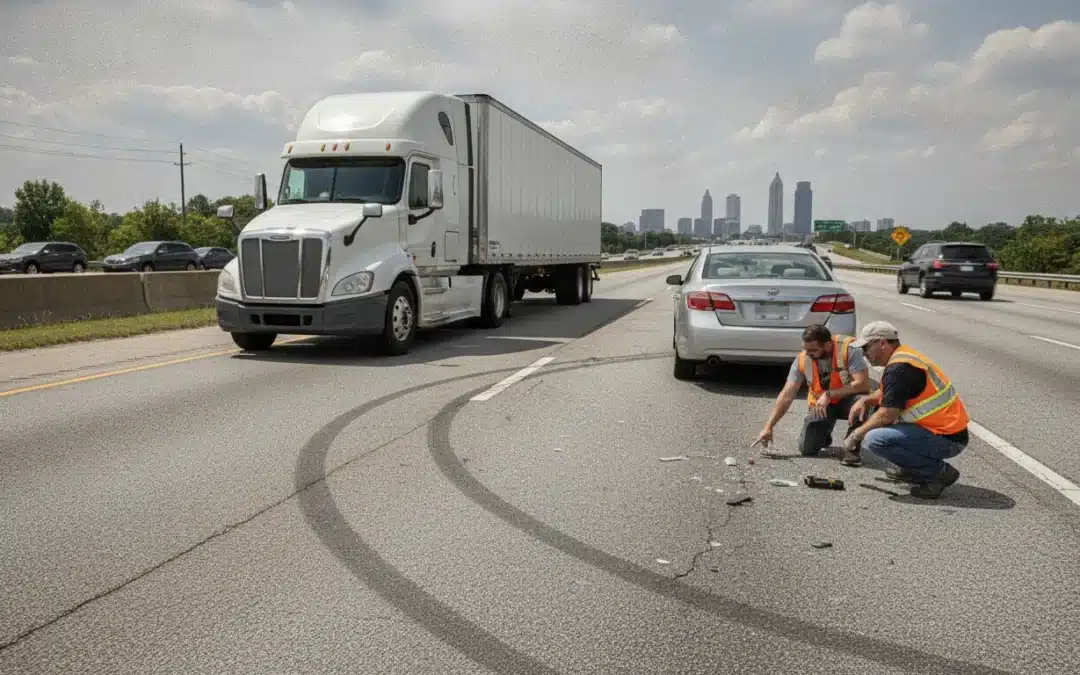
Scene and vehicle evidence can preserve facts that ordinary photographs miss. Professional crash investigators commonly document the roadway, vehicle damage, final rest positions, marks on the pavement, occupant contact points, and safety systems. NHTSA describes scene inspection, vehicle inspection, photographs, witness or victim interviews, and official records as parts of an in-depth crash investigation. NHTSA’s crash-investigation overview provides useful background.
Evidence note: Roadway marks and vehicle damage may help investigators reconstruct what happened.
Useful scene evidence may include:
- Photographs and video from different distances and angles, including signs, signals, lane markings, lighting, weather, and obstructions.
- Photographs of the tractor, trailer, passenger vehicle, tires, underride guards, lights, mirrors, cargo area, and visible damage before repairs or salvage.
- Measurements and documentation of skid, yaw, gouge, debris, fluid, and tire marks.
- Police reports, 911 information, citations, photographs, body-camera footage when available, and nearby business or roadway camera footage.
- Names and contact information for witnesses, passengers, first responders, tow operators, and people who saw the vehicles shortly before or after impact.
Do not put yourself in danger to gather evidence at an active crash scene. If you can safely take photographs, preserve the original files and avoid editing them. If the vehicle has been towed, sold, repaired, or declared a total loss. Tell your attorney and insurer promptly so preservation decisions can be made before physical evidence changes.
Which truck, driver, and carrier records matter?
Commercial trucking cases often involve more than the driver and the company name printed on the tractor. The responsible entities may include a motor carrier, vehicle owner, leasing company, broker, shipper, maintenance provider, or insurer. A lawyer should identify those relationships rather than assuming that a truck’s door marking alone establishes legal responsibility.
Records that may matter include:
- Driver qualification, training, supervision, disciplinary, and employment records.
- Hours-of-service and electronic logging device records, along with supporting documents and edits.
- Pre-trip and post-trip inspections, repair orders, maintenance histories, recalls, and defect reports.
- Dispatch messages, GPS or telematics data, route information, delivery deadlines, and communications about the trip.
- Bill of lading, loading, weight, cargo securement, and inspection records when cargo or loading may have contributed to the collision.
- Carrier safety history, policies, prior complaints or incidents, and documents showing who controlled hiring, training, maintenance, or dispatch decisions.
FMCSA guidance states that a motor carrier must retain drivers’ records of duty status and supporting documents for six months. With a back-copy of ELD records on a separate device for that period. Read the FMCSA ELD retention guidance. That retention period is one reason a prompt preservation request can matter. It does not mean every record in every case is kept for exactly six months, and it does not replace case-specific legal advice.
How can electronic data help, and what can it not prove?
Electronic evidence can help explain what occurred immediately before a collision. But it is not a complete video of the trip and it does not decide liability by itself. The existing Schneider Injury Law resource on 18-wheeler black-box data provides a more technical discussion of ECM, EDR, and ELD records. This article focuses on how that evidence fits into the larger case.
NHTSA explains that an event data recorder may capture technical vehicle and occupant information for a brief period around a crash. Depending on the system, that can include pre-crash vehicle dynamics, driver inputs, crash signature, and restraint information. An EDR is not automatically an audio or video recorder, and the available information varies by vehicle and system. FMCSA’s ELD guidance addresses a different category of records, focused on a driver’s records of duty status.
Investigators may compare electronic information with physical damage, scene marks, witness accounts, camera footage, and the driver’s and carrier’s records. If one record conflicts with another, that conflict may identify a question that needs further investigation. Do not assume that a missing device or incomplete data makes a case impossible. Cases are evaluated using the evidence that is available and reliable.
What medical and financial evidence shows the impact of the crash?
Evidence about fault explains why the crash happened. Medical and financial evidence explains what the crash did to the person who was injured. In a serious 18-wheeler collision, that proof may include emergency records, diagnostic imaging, surgery records, rehabilitation notes, prescriptions, specialist opinions, and a documented treatment plan.
When injuries affect memory, mobility, work, or family responsibilities, the record should show those changes without exaggeration. A daily symptom log, treatment history, work documentation, and testimony from people who provide care can give context that a single bill cannot. Schneider Injury Law’s catastrophic injury guidance explains why serious injuries may require evidence of ongoing care and long-term support.
Keep copies of:
- Emergency department, hospital, surgical, and follow-up records.
- Imaging, test results, referrals, therapy notes, and medication information.
- Medical bills, health-insurance statements, mileage, equipment costs, and out-of-pocket expenses.
- Pay records, tax information, job duties, missed work, reduced capacity, and employer documentation.
- A practical record of pain, sleep disruption, mobility changes, cognitive symptoms, household limitations, and the help provided by family members.
Be accurate and consistent when speaking with medical providers and insurers. Do not minimize symptoms because they were not visible at the scene, and do not assume that a gap in treatment automatically determines the value of a claim. Medical causation, prognosis, and future needs require review of the individual facts by qualified professionals.
What should you do if a trucking company or insurer contacts you?
After a serious crash, a carrier’s insurer or a claims representative may ask for a recorded statement, broad medical authorization, inspection access, or a quick settlement. Those requests can have legal consequences. You can be polite without making decisions before you understand what is being requested.
- Get immediate medical care and follow the treatment plan given to you.
- Preserve photographs, videos, damaged property, clothing, vehicle information, and witness details.
- Keep written communications and voicemails from the carrier, insurer, driver, or trucking company.
- Avoid posting crash details or medical updates publicly while a claim is being evaluated.
- Do not sign a release, give a recorded statement, or accept a settlement without understanding the legal effect.
- Contact a lawyer promptly if the injuries are serious, a death occurred, fault is disputed, or the carrier has begun its investigation.
Georgia’s general personal-injury limitation rule is often discussed under O.C.G.A. section 9-3-33. It generally provides a two-year period for personal-injury actions, subject to exceptions and other rules. Review the Georgia statutory text, and do not treat it as a deadline calculation for your case. A different deadline, notice requirement, claim type, or fact pattern may apply. Waiting can also make evidence harder to preserve even when a filing deadline has not arrived. Schneider’s Georgia truck accident deadline guide provides additional general background.
When should you contact an 18 wheeler accident lawyer in Georgia?
A consultation is especially important when a crash caused catastrophic injury, a fatality, surgery. Permanent impairment, disputed fault, multiple vehicles, a commercial vehicle inspection issue, or contact from a trucking insurer. Early legal involvement can help identify the entities involved, preserve records, coordinate evidence review, and prevent a rushed decision from controlling the claim.
Schneider Injury Law is an Atlanta-based boutique trial firm representing seriously injured people throughout Georgia. Bethany Schneider brings former defense-side experience to cases involving trucking companies and insurers. The firm’s contingency arrangement means no fee UNTIL we win, with no retainers or upfront fees. A consultation is an opportunity to understand the evidence and possible next steps, not a promise of a particular result.
Claim Your Free Case Evaluation
Frequently asked questions
What is the most important evidence after an 18-wheeler crash?
There is no single most important item in every case. The scene, vehicles, witnesses, commercial records, electronic data, and medical documentation may each answer different questions. Preserving the evidence promptly is usually more important than trying to decide on your own which item will ultimately control.
How long are electronic logging device records kept?
FMCSA guidance says motor carriers must retain records of duty status and supporting documents for six months. With a back-copy of ELD records on a separate device for six months. The exact records available in a case depend on the carrier, vehicle, system, and facts. This is not a reason to delay a preservation request.
Does an 18-wheeler black box prove who caused the crash?
No. EDR, ECM, and ELD information may help investigators understand vehicle operation, driving time, or events around impact. The data must be interpreted with scene evidence, physical damage, witness accounts, camera footage, and other records. Electronic evidence alone does not automatically establish legal responsibility.
What if the trucking company already inspected the vehicles?
Tell your attorney what you know, including when the inspection occurred and whether photographs or reports were provided. A carrier’s investigation may preserve useful information, but an injured person’s interests and the carrier’s interests are not necessarily the same. Independent review may be appropriate.
Can I have a case if there were no witnesses?
Possibly. A case may rely on photographs, vehicle damage, roadway marks, police and medical records. Electronic information, expert analysis, and testimony from people who observed the vehicles before or after the collision. The strength of the evidence depends on the facts and available records.
How quickly should I speak with a lawyer?
Speak with a qualified lawyer promptly when injuries are serious or a death occurred. Especially before giving a recorded statement, signing a release, or allowing damaged evidence to be discarded. Deadlines and evidence-preservation needs are case-specific, so a general online article cannot calculate your legal rights.
Attorney-reviewed by Bethany Schneider, Schneider Injury Law trial attorney. Reviewed September 21, 2026.
This article is for general information only and is not legal advice. Every case is different. A consultation does not create an attorney-client relationship.