
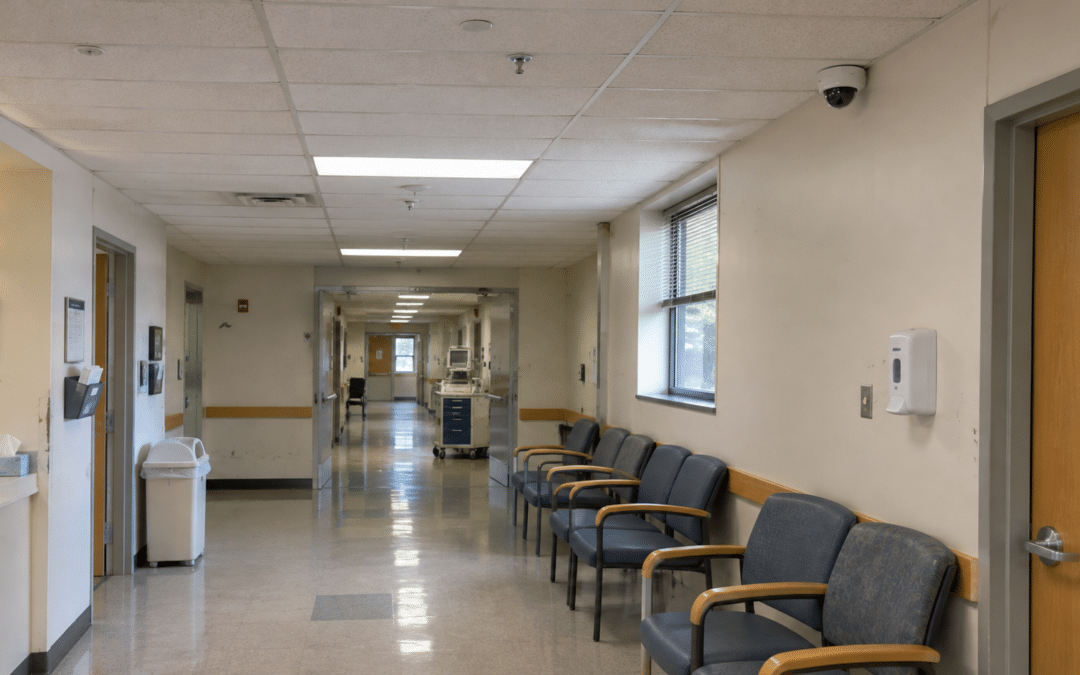
When a serious medical emergency occurs in a hospital, families often look to the cameras. It is natural to assume that security cameras in emergency department waiting areas or public corridors recorded every critical moment—when you arrived, how long the patient waited, requests for help, and when staff intervened.
Finding out that video is unavailable, overwritten, or was never recorded can be deeply frustrating. However, missing surveillance footage does not automatically prevent a medical malpractice claim. An attorney may use clinical records, electronic chart information, available device data, and expert review to investigate what happened. If you believe a loved one was harmed by substandard medical care in Georgia, Schneider Injury Law can help you understand your options.
Claim Your Free Consultation Today!
Reviewed by Bethany Schneider, Founder, Schneider Injury Law | Updated November 4, 2026
What Hospital Surveillance Footage May Show
Where security cameras are present and operational, footage may document events that are not fully captured in the medical chart, such as:
- Arrival and registration: The time a patient entered the building and approached the intake or triage desk.
- Waiting intervals: The duration a patient spent in an emergency department waiting area before being called for evaluation.
- Visible distress: Outward physical symptoms that appear on camera, such as sudden collapse, respiratory difficulty, or severe pain.
- Requests for assistance: Family members repeatedly approaching a nurses' station or desk to seek help.
- Staff movement: The physical presence or transit of healthcare personnel through hallways and shared areas.
While video recordings can establish that an event occurred at a certain time and place, they do not answer the central question in a malpractice case: whether the medical care provided met the applicable standard of care.
Why Hiring an Attorney Early Can Help Preserve Hospital Video
Hospital surveillance footage may be overwritten before a family receives medical records or gets answers about what happened. Some surveillance systems delete or overwrite recordings in as little as seven days, depending on the facility’s system and retention settings. Families should not assume that reporting a concern or requesting a medical chart will also preserve security video.
Hiring an attorney promptly allows preservation letters to be sent to the hospital and any outside companies that control relevant recordings. These letters can identify the date, time window, and locations involved and request that relevant footage be preserved before routine deletion occurs. Although a letter cannot guarantee preservation, sending it early can help protect evidence that may otherwise disappear.
If the footage has already been deleted, a medical malpractice investigation may still be possible using clinical records, device data, and other available evidence.
What Video Cannot Establish on Its Own
Surveillance cameras capture outward physical actions, but they cannot show internal physiological changes or clinical decision-making. Video alone cannot establish:
- What clinicians knew: A hallway camera cannot document laboratory values, vital sign trends on bedside monitors, or diagnostic images available to the medical team.
- Medical reasoning: Video cannot explain the differential diagnoses a doctor considered, why particular tests were chosen or deferred, or the rationale behind a medication order.
- Medical causation: Showing that a patient waited a certain amount of time does not, by itself, establish whether an earlier medical intervention would have changed the clinical outcome.
Georgia medical malpractice claims generally require qualified medical expert evidence concerning the standard of care and causation. Expert qualifications depend on statutory requirements and the particular care being evaluated. An expert must evaluate clinical records and diagnostic findings to determine whether a standard of care was breached and whether that breach caused the injury.
How Other Records Can Reconstruct the Clinical Timeline
When surveillance video is unavailable or incomplete, attorneys and medical experts rely on the clinical and electronic records generated during patient care to reconstruct a detailed timeline.
1. Triage Assessments and Vital Signs
Initial triage notes record the chief complaint, assigned acuity level, and baseline vital signs (blood pressure, heart rate, pulse oximetry, respiratory rate, and temperature). Subsequent nursing flow sheets and reassessments track whether and when vital signs were checked again.
2. Medication Administration Records (eMAR) and Dispensing Logs
Electronic Medication Administration Records (eMAR) document when a clinician logged the administration of a drug, but recorded times may need verification against other data. Automated dispensing cabinets maintain separate transaction logs showing when medications were removed from inventory. If the concern involves the wrong drug or dose, read our guide to hospital medication errors in Georgia.
3. Orders and Diagnostic Reports
Hospital systems may record timestamps showing when orders were submitted, when tests were performed, and when results became available.
4. Electronic Health Record (EHR) Audit Records
Behind the visible chart, electronic health record systems generate audit data. Depending on the system and its configuration, audit records may identify access, entries, changes, and associated timestamps. When investigating whether notes were entered long after the care was delivered or updated following a bad outcome, audit records and chart version histories may need to be reviewed together.
5. Biomedical Monitor and Device Data
Some biomedical devices—including cardiac monitors, defibrillators, telemetry packs, and ventilators—may retain waveforms or event logs, depending on the equipment, device settings, and facility data-retention practices.
Why Timestamps May Conflict
Discrepancies in hospital timelines often arise from how data is recorded rather than intentional manipulation:
- Event Time vs. Documentation Time: In urgent situations, clinical care comes before computer data entry. Clinicians frequently enter their notes after an acute event has stabilized ("late entry charting"). The system timestamp reflects when the entry was keyed into the computer, not necessarily the moment the physical event occurred.
- Unsynchronized Device Clocks: Security cameras, bedside monitors, telemetry servers, and electronic health record systems do not always share synchronized internal clocks. Reconstructing a master timeline requires accounting for these potential offsets.
Whether Footage Was Deleted—or Never Existed
Before addressing potential loss of evidence, an investigation evaluates whether footage was recorded in the first place:
- Uncovered Areas: Security cameras are generally positioned for building safety and entrance security; many clinical and patient-care areas have no camera coverage.
- Inactive Equipment: Cameras may be non-operational, disconnected, or angled away from the relevant location.
- Automated Retention Schedules: Video surveillance systems commonly record over older files according to a retention schedule that varies by facility and system.
- Saved or Exported Clips: If an incident or security event was flagged internally, hospital personnel may have exported specific video clips before automated overwriting occurred.
What an Attorney May Seek to Preserve
When legal counsel is retained early, an attorney can issue formal evidence preservation demands requesting that the facility and its security vendors secure:
- Relevant surveillance video covering all pertinent areas, entrances, and corridors during the critical time window.
- System logs, camera retention settings, and records of any video exports or deletions.
- Unfiltered electronic health record audit logs and version histories.
- Raw event and waveform data from applicable biomedical monitoring devices.
What Missing Footage Means for a Potential Claim
When a hospital fails to preserve video after a legal duty to preserve has attached, the legal doctrine of spoliation may allow a court to consider remedies or sanctions. However, surveillance video is rarely the sole basis of a medical negligence lawsuit. A claim may still be supportable without video, depending on the remaining evidence and expert assessment.
Frequently Asked Questions
Can an electronic chart show when a note was written or modified?
Electronic health record systems track chart activity through metadata and audit records. Depending on the software, audit trails and chart version histories can show when an entry was created, viewed, or edited, and by which user account.
How quickly should we consult an attorney if we suspect negligence?
Prompt consultation is critical. Although Georgia's general statute of limitations for medical malpractice is generally two years, subject to exceptions and other statutory limits, video surveillance recordings, automated device caches, and temporary electronic logs can be overwritten according to routine facility schedules if preservation notices are not issued promptly.
Why Choose Schneider Injury Law?
Medical malpractice cases require thorough factual investigation, detailed technical analysis of electronic records, and qualified medical experts.
Bethany Schneider founded Schneider Injury Law after practicing at King & Spalding, one of the nation's premier defense litigation firms. She brings that institutional perspective to holding healthcare systems accountable when preventable errors cause catastrophic harm.
Schneider Injury Law represents individuals and families across Georgia on a contingency fee basis, meaning no attorney fees are owed unless compensation is recovered.
Claim Your Free Consultation Today!
Disclaimer: This article is for informational purposes only and does not constitute legal advice. Medical malpractice claims in Georgia involve complex statutory deadlines and evidence standards. Reading this article or contacting our office does not create an attorney-client relationship. Consult a licensed Georgia attorney about the specific facts of your situation.