

If you are looking for truck accident I-285 Atlanta legal rights information after a collision, you may be dealing with more than vehicle damage. A tractor-trailer crash can involve serious injuries, several commercial entities, fast-moving evidence, and an insurer that begins investigating before you know the full extent of your losses. This guide explains the practical rights and steps that matter after a truck crash on I-285, I-85, or a connected Atlanta corridor. For the broader strategy used in complex commercial-vehicle cases, see our Atlanta trucking accident trial lawyer guide.
Call 404-800-3060 for a Free Case Evaluation
Why I-285 and I-85 Create Difficult Truck Crash Investigations
I-285 and I-85 bring together heavy commercial traffic, high-speed travel, short merge decisions, construction changes, and multiple lanes of drivers with different destinations. Those conditions do not prove who caused a crash, but they make scene position, lane markings, vehicle data, witness accounts, and timing especially important to a fair investigation.
Atlanta’s interstate system is designed around movement between major routes. Trucks may be traveling around the Perimeter, entering or leaving I-85, connecting with I-75 or I-20, or moving freight through the metro area. A crash report may identify a general location, but the legal questions often require a closer reconstruction of the lanes, ramps, sight lines, traffic control, and sequence of impacts.
Potential conflict points include:
- The I-285 and I-85 interchange in northeast Atlanta, where high-volume lanes and ramps converge.
- The I-285 and I-85 connection on the southwest side of the metro area, where freight traffic and local trips share changing lane patterns.
- I-85 approaches near major Atlanta interchanges, where vehicles enter, exit, slow, and change lanes in limited space.
- Construction and lane-shift areas on I-285 or I-85, where temporary markings and narrowed lanes can affect driver decisions.
- Shoulders, breakdown areas, and secondary-crash locations, where a disabled vehicle or debris can create a second collision.
These are investigation locations, not a formal ranking of crash frequency. The Georgia Department of Transportation’s traffic data resources can provide roadway context, while a case-specific investigation must determine what happened in the particular crash.
What Are the Most Important I-285 and I-85 Truck Accident Hotspots?
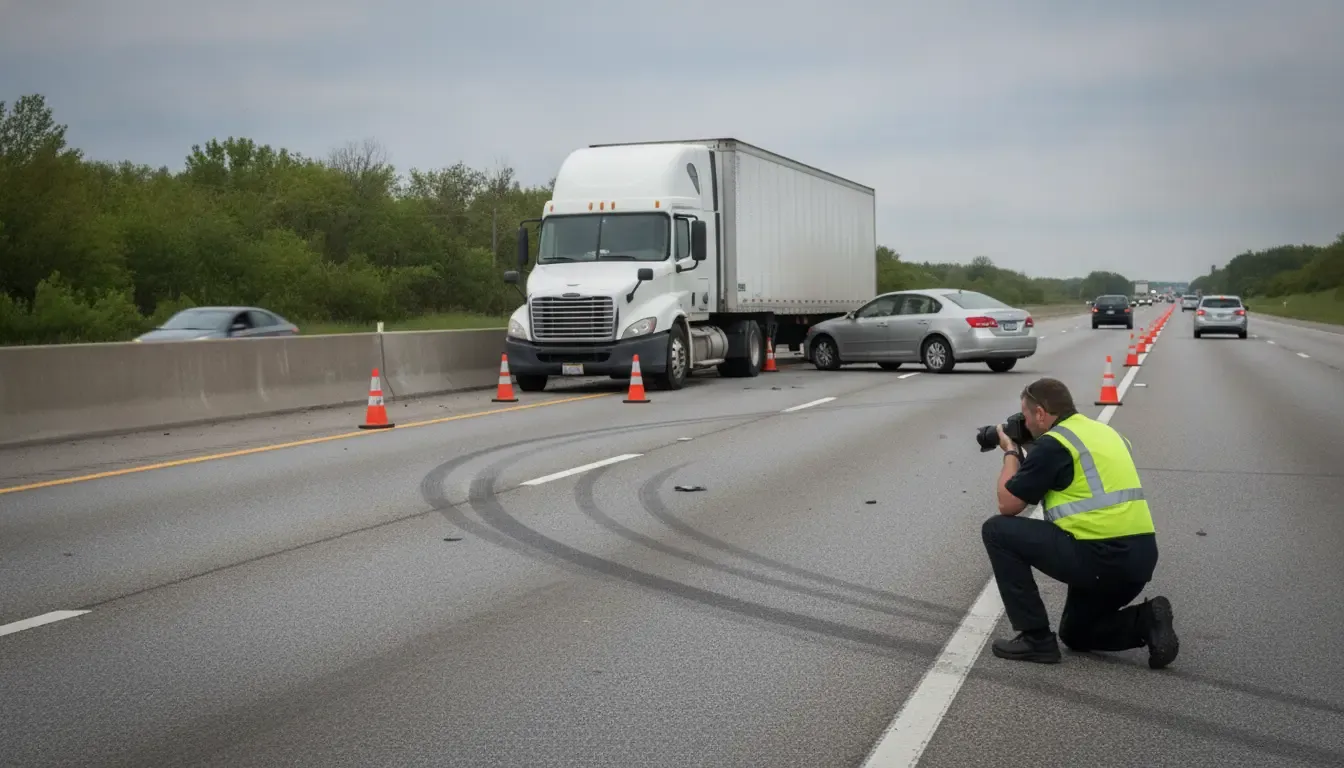
The most important hotspot is often the specific conflict point, not a roadway label alone. Interchanges, merge lanes, lane shifts, ramps, and nearby shoulders can reveal whether a truck was changing lanes, following too closely, braking, drifting, or reacting to another vehicle. Photographs and measurements should capture that context before conditions change.
When a crash occurs near I-285 or I-85, note the direction of travel, nearest exit, mile marker, ramp, lane, and any visible construction or temporary traffic control. A location that sounds simple, such as “I-285 near I-85,” may include several ramps and separate crash scenes. Emergency responders, roadway cameras, 911 records, and witnesses may help establish which segment and movement were involved.
Location evidence can also help explain why a driver did or did not have time to react. That does not replace witness testimony or a qualified reconstruction. It gives the investigation a starting point and may help identify evidence to request quickly. Do not post a public theory about fault based only on a photograph or a traffic map.
Who May Be Responsible for an Atlanta Truck Crash?
Depending on the facts, responsibility may involve the truck driver, motor carrier, truck owner, cargo loader, maintenance provider, broker, shipper, or a manufacturer. A commercial-truck claim should identify which entity controlled the conduct at issue and whether that conduct contributed to the collision. The presence of a company logo alone does not establish liability.
A focused investigation may examine:
| Potential source of responsibility | Questions the evidence may answer |
|---|---|
| Driver | Was the driver distracted, speeding, fatigued, impaired, or operating unsafely for traffic and weather? |
| Motor carrier or employer | Did the company hire, train, supervise, dispatch, or retain the driver appropriately? |
| Truck owner or leasing company | Who controlled inspection, maintenance, repairs, and equipment decisions? |
| Cargo or loading parties | Was cargo secured, balanced, and loaded in a way that affected stability or stopping? |
| Broker, shipper, or contractor | Did another business control a relevant safety decision or selection process? |
These categories are not a conclusion that every listed party is liable. They are a reminder that the name on the trailer may not identify every relevant decision-maker. Carrier markings can be an investigation lead, but fault must be tied to evidence and the specific facts of the crash.
Schneider Injury Law’s broader Atlanta trucking accident trial counsel resource explains how a defense-insider perspective can help test the positions a carrier or insurer may take. The resource focuses on the trial-ready investigation of serious commercial-vehicle claims.
What Evidence Can Protect Your Legal Rights After a Truck Crash?
The most useful evidence may include the crash report, photographs, witness information, medical records, vehicle data, dashcam or roadway video, dispatch records, driver logs, inspection and maintenance records, cargo documents, and communications with insurers. You have the right to seek medical care and to consult counsel before giving a detailed statement about a serious injury claim.
Evidence can be lost for ordinary reasons. Vehicles are repaired, roadway debris is removed, video systems overwrite older footage, witnesses leave the area, and injuries become harder to connect to a single event when treatment is delayed. If you can do so safely, record:
- The direction of travel, lane, nearest exit, mile marker, and intersection or ramp.
- Vehicle positions, damage, license plates, debris, tire marks, road surface, signs, and traffic controls.
- Names and contact information for witnesses and responding officers.
- Symptoms and treatment, including follow-up care that may not occur at the crash scene.
- Insurance letters, calls, forms, photographs, and any request for a recorded statement.
Do not put yourself or another person in danger to collect evidence on an interstate. Ask law enforcement how to obtain the crash report. Preserve original photographs and messages instead of editing or deleting them. For a deeper discussion of electronic vehicle evidence, see the firm’s guide to 18-wheeler black box data in Georgia truck accidents.
Can Hours-of-Service Records Matter in a Truck Accident Claim?
Hours-of-service records can matter when fatigue or an unsafe schedule may have contributed to a crash, but a rule violation is not automatically proof of causation. The Federal Motor Carrier Safety Administration summarizes limits for property-carrying drivers, including an 11-hour driving limit after 10 consecutive hours off duty and a 14-hour on-duty window.
The FMCSA hours-of-service summary is a useful starting point for understanding the rules. In a specific case, investigators may need to compare logs with dispatch messages, fuel and toll records, GPS or telematics data, delivery schedules, rest records, and witness observations.
Hours-of-service evidence is only one part of a commercial-vehicle investigation. Other questions may concern inspection, repairs, tires, brakes, cargo securement, driver qualification, training, alcohol or drug testing, and the carrier’s response after the crash. A claim should not assume a violation, and it should not ignore a potentially important record simply because the police report does not discuss it.
What Should You Do in the First 72 Hours After an I-285 Truck Accident?
In the first 72 hours, prioritize safety and medical care, report the crash, preserve information, avoid guessing about fault, and be careful with insurer communications. Write down what you remember while it is fresh, follow medical instructions, and obtain legal guidance before signing a release or making a recorded statement about a serious injury.
- Get to a safe place. Call 911 and follow emergency responders’ instructions. Do not walk into live interstate traffic to photograph a vehicle or debris.
- Accept or arrange medical evaluation. Some serious injuries develop or become clearer after the initial emergency response. Keep records of symptoms, diagnoses, referrals, and missed work.
- Preserve the scene information. Save photographs, videos, witness details, vehicle information, and the exact roadway location.
- Notify your own insurer as required by your policy. Give accurate basic facts, but do not speculate about fault, minimize injuries, or agree to a broad release before you understand the claim.
- Keep communications. Save letters, emails, text messages, claim numbers, and requests for statements or medical authorizations.
- Consult an Atlanta truck accident lawyer promptly. Early legal guidance can help identify preservation requests and potential parties without promising a particular outcome.
Schneider Injury Law serves injured people in Atlanta and throughout Georgia. Bethany Schneider’s former defense-side experience gives the firm insight into how corporations and insurers may evaluate a serious claim, while the firm’s boutique model provides direct access to trial counsel.
How Long Do You Have to Bring a Georgia Truck Accident Claim?
Georgia Code section 9-3-33 generally provides a two-year period for personal-injury actions, but that general rule does not answer every truck-crash case. Different facts may involve wrongful death, minors, government entities, notice requirements, insurance issues, or other exceptions. A deadline analysis should be based on the actual claim, not a calendar estimate.
Read the current text of Georgia Code section 9-3-33, then speak with a Georgia attorney about how the law applies to your facts. Waiting can make it harder to preserve video, vehicle data, physical evidence, and witness testimony even before a filing deadline becomes urgent.
Do not assume that an insurer’s investigation protects your legal rights. The insurer represents its policyholder and has its own interests. A consultation can help you understand possible claims, evidence, deadlines, and next steps without requiring you to decide everything during the first conversation.
Call 404-800-3060 for a Free Case Evaluation
Frequently Asked Questions About I-285 and I-85 Truck Crashes
Where do truck accidents happen most often on I-285?
Truck crashes can occur anywhere on I-285. Interchanges, merge lanes, lane shifts, congestion points, ramps, and shoulder areas deserve close investigation because vehicles must make rapid speed and lane decisions there. A location is not proof of fault, and a case-specific review should use the exact exit, lane, direction, and available evidence.
Can I sue the trucking company after a crash?
Possibly. The answer depends on the driver’s relationship to the carrier, the company’s conduct, and evidence connecting a party’s actions to the collision and injuries. A carrier, truck owner, loading company, maintenance provider, broker, or another entity may be relevant, but no party should be accused without a factual and legal basis.
What if the truck driver’s insurer asks for a recorded statement?
Give required basic notice to your own insurer, but consider speaking with a lawyer before providing a detailed recorded statement to another insurer. Do not guess, speculate, minimize symptoms, or sign a release before you understand what it covers and whether additional treatment or investigation is needed.
What evidence should I save after an I-285 truck accident?
Save the crash report, photographs, videos, witness information, medical records, vehicle and insurance information, messages, claim letters, and notes about symptoms and treatment. A lawyer may also seek electronic vehicle data, dashcam or roadway video, driver logs, dispatch records, maintenance files, and cargo documents.
How much does it cost to speak with Schneider Injury Law?
All consultations are free. There are no retainers or upfront fees. The firm’s contingency arrangement is described accurately as no fee UNTIL we win, but every case is different and no outcome is guaranteed. Contact the firm to discuss the facts of your potential claim.
Disclaimer: This article is for general educational information and is not legal advice for a specific crash. No attorney-client relationship is created by reading it. Deadlines, responsible parties, and available claims depend on the facts, so speak with a licensed Georgia attorney about your situation.