
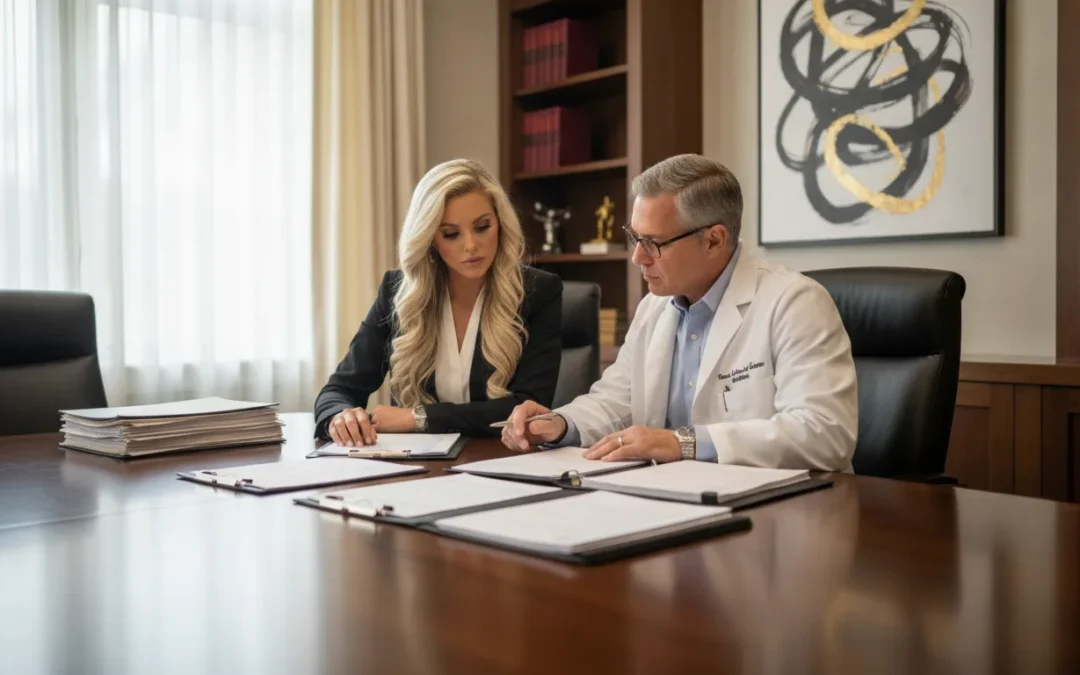
If you are trying to understand whether a serious medical injury may support a claim, an attorney for medical malpractice does not begin with a bad outcome alone. The first review usually asks whether the records show a possible departure from the applicable standard of care, whether that departure may have caused additional harm, and whether a qualified expert can explain those issues clearly and reliably.
That process is often called an expert review. It is not a promise that a claim will be filed or accepted. It is a structured way to test the facts before a patient or family takes on the cost, time, and emotional strain of litigation. This guide explains what counsel and a medical expert typically look for, what can make a review difficult, and what Georgia families can do next.
What is an expert review in a medical malpractice case?
An expert review is a focused evaluation of the medical records and other evidence by a qualified healthcare professional. The expert considers what happened, what a reasonably careful provider in the same field and circumstances might have done, and whether the difference could have caused a specific injury.
The attorney’s job is broader than sending records to a doctor. Counsel must identify the legal questions, develop a reliable timeline, determine which providers and entities may matter, and test whether the medical opinion can be supported by admissible evidence. A useful review connects the clinical analysis to the patient’s actual injury and to the legal requirements that apply in Georgia.
A poor result, a complication, or a disagreement with a provider does not automatically establish negligence. Some treatment risks occur even when care is reasonable. The review is meant to separate a possible care failure from an unfortunate outcome that the available evidence does not connect to negligence.
What records does a medical malpractice attorney examine first?
The attorney usually starts by building a complete chronology. A single discharge summary or a patient’s recollection may not show the full sequence of decisions. Counsel looks for the records that reveal what providers knew, when they knew it, what they ordered, what they communicated, and how the patient’s condition changed.
| Evidence category | What it may help clarify | Review question |
|---|---|---|
| Progress notes and nursing notes | Symptoms, assessments, escalation, and changes in condition | Was a warning sign documented and addressed? |
| Orders, medication records, and administration records | What was ordered, given, held, or changed | Does the medication timeline match the patient’s condition? |
| Imaging, laboratory results, and pathology | Objective findings and timing of results | Were abnormal findings recognized and acted on? |
| Operative, anesthesia, and procedure records | Technical steps, monitoring, and complications | Does the record support the proposed standard-of-care analysis? |
| Discharge instructions and follow-up records | Warnings, return precautions, and continuity of care | Was the patient given appropriate guidance for a changing condition? |
| Billing, employment, and functional records | Treatment expenses, lost work, and daily limitations | What harm followed, and what evidence supports it? |
Missing records do not prove that negligence occurred, and a complete chart does not eliminate every question. They do affect the strength and reliability of an opinion. Counsel may need records from multiple facilities, emergency medical services, pharmacies, specialists, employers, or later treating providers. The attorney also checks whether dates, names, medication lists, and clinical notes fit together or reveal an unresolved conflict.
How does the attorney identify the standard of care?
The standard of care is not simply the treatment choice that produced the best result in hindsight. The expert asks what a reasonably careful provider with comparable training and experience would have considered and done under the circumstances known at the time.
That analysis can depend on the specialty, setting, urgency, available information, patient history, equipment, and the provider’s role. A radiologist, emergency physician, surgeon, nurse, anesthesiologist, and hospital may have different responsibilities in the same episode. The review should identify the specific act or omission under examination rather than use a broad conclusion that “the hospital was negligent.”
An attorney looks for a precise, defensible opinion. For example, an expert may need to explain whether a diagnostic result should have triggered a different follow-up, whether a medication decision departed from accepted practice, or whether a surgical event was preventable under the facts. The question is not whether another provider might have chosen differently. The question is whether the proposed opinion can be grounded in the applicable professional standard and the records.
Georgia’s professional negligence rules can make expert analysis important at the beginning of a case. O.C.G.A. section 9-11-9.1 addresses the affidavit requirements that may apply when a complaint alleges professional negligence, subject to statutory exceptions and procedural rules. An attorney should confirm the current requirements for the specific defendant and claim before filing anything.
What does the expert need to say about causation?
A review must do more than identify a possible departure from the standard of care. It must examine whether the alleged departure caused additional injury. This is often where medical malpractice cases become more difficult.
The attorney compares the patient’s condition before the event, during the relevant treatment, and afterward. The analysis may involve the underlying disease, the natural progression of the condition, earlier symptoms, later treatment, and other possible causes. A close timeline can raise a serious question, but timing by itself does not prove medical causation.
A useful expert opinion should explain the connection in medical terms. It might address whether earlier diagnosis would likely have changed treatment, whether delayed intervention increased the severity of an injury, or whether a medication error caused a distinct complication. It should also acknowledge limits and alternative explanations instead of assuming that every later problem came from the disputed care.
Counsel therefore looks for an opinion that answers three separate questions: what should have happened, what actually happened, and how the difference affected the patient. If the opinion addresses only the first question, it may not support the claim the family needs to pursue.
How does an attorney evaluate the expert’s qualifications?
The expert must be qualified for the opinions the case requires. That does not mean a famous doctor is automatically the right expert. Counsel examines the expert’s education, current or recent practice, specialty, clinical experience, familiarity with the relevant procedure or condition, and ability to explain the opinion without overreaching.
Fit matters. A physician who understands a diagnosis may not be the best person to address a complex surgical technique. A specialist who treats the condition today may need to explain how the relevant practice operated at the time of the event. The attorney also asks whether the expert’s background matches the defendant’s role and the precise criticism being made.
Georgia’s evidence rules address the use of expert opinion testimony, including the expert’s knowledge, skill, experience, training, or education and the reliability of the principles and methods used. The Georgia General Assembly’s official code resource is the place to confirm the current text of the applicable evidence provisions, including O.C.G.A. section 24-7-702. The details matter, and the statute should be reviewed with counsel rather than reduced to a checklist.
An attorney may also consider whether the expert can withstand careful questioning. A strong opinion should distinguish facts from assumptions, identify the records reviewed, explain the reasoning, and respond fairly to contrary information. An expert who promises certainty where the records are incomplete can create a credibility problem instead of solving one.
Request a free Georgia medical malpractice case review with Schneider Injury Law. You do not need to decide the legal conclusion before you ask what the records may show.
What red flags can weaken an expert review?
An attorney for medical malpractice looks for weaknesses before the defense does. That is not a reason to dismiss a family or minimize what happened. It is a way to make the evaluation honest and to avoid pursuing a theory that the records cannot support.
- Incomplete records: Important imaging, medication records, operative notes, or follow-up information may be missing.
- Unclear criticism: The concern may describe a bad outcome without identifying the specific decision or action that allegedly fell below the standard of care.
- Competing causes: The underlying condition, later event, or pre-existing impairment may offer another explanation for the injury.
- Timeline conflicts: The patient’s account, chart entries, billing history, and witness statements may not align.
- Expert mismatch: The proposed reviewer may lack experience with the relevant specialty, procedure, setting, or time period.
- Unsupported damages: The medical opinion may not connect the claimed limitations or treatment needs to the event being investigated.
- Procedural concerns: Filing deadlines, defendant identity, notice rules, or affidavit requirements may affect how and whether a claim proceeds.
Red flags are questions for investigation, not automatic findings against the patient. A careful lawyer may request more records, consult a different specialist, narrow the theory, or advise that the available evidence does not support a claim. That candor protects the client’s time and helps keep the legal process grounded in proof.
How is the expert review different from proving the entire case?
An expert review is one part of case evaluation. It can help establish the medical questions, but it does not replace the attorney’s work on parties, legal theories, damages, timing, evidence preservation, and litigation strategy. It also does not guarantee that a court will accept an opinion or that a jury will agree with it.
Schneider’s existing guide on how to prove medical negligence in Georgia explains the broader proof structure. The article on evaluating medical malpractice cases provides a shorter overview of records, standard of care, and causation. Those resources address neighboring questions. This guide focuses narrowly on the screening work behind an expert review and the practical questions counsel asks before relying on it.
That distinction matters because a case may have a persuasive medical concern but still require more evidence about the defendant, causation, damages, or procedure. Conversely, a record that initially looks troubling may become clearer after a qualified expert considers the full context.
What should a Georgia patient or family do before requesting a review?
- Seek appropriate medical care for any current or worsening condition. Legal evaluation should not delay treatment.
- Keep the original medical records, messages, bills, discharge instructions, and photographs in their original form. Do not edit or annotate the only copy.
- Write a factual timeline while the details are fresh, including providers, facilities, symptoms, questions, and follow-up care.
- Request relevant records and keep a list of missing items. If a facility uses a portal, preserve downloads and notices about access.
- Tell counsel about later treatment, prior conditions, employment effects, and any communication with providers or insurers.
- Ask what additional records or expert issues may be needed and whether the firm can evaluate the matter within the applicable Georgia deadlines.
You do not need to label the event as malpractice before speaking with an attorney. Describe what happened, what changed, and what records you have. The legal and medical review can then focus on the questions the evidence actually raises.
Frequently asked questions about expert review
Does a bad medical outcome prove malpractice?
No. A bad outcome can happen even when a provider acted reasonably. An attorney and qualified expert look for a specific departure from the applicable standard of care and a supported connection between that departure and the patient’s injury.
Does every medical malpractice case require an expert?
Expert needs depend on the claim, the medical issues, the defendant, and applicable Georgia procedure. Many professional-negligence questions require specialized testimony, but counsel should evaluate the particular facts rather than apply a universal rule.
What if I do not have my complete medical records?
You can still ask for an initial conversation. Tell the attorney which records you have and where you were treated. Counsel can explain what may be needed for a meaningful review and how to request additional records.
Can an attorney tell me whether I have a case during the first call?
Sometimes an initial conversation identifies an obvious next step, but a responsible attorney may need records and expert input before reaching a conclusion. A consultation is an opportunity to understand the process, not a guarantee that the firm will accept the case or that any outcome will follow.
What should I do if my condition is still changing?
Prioritize appropriate medical care and follow-up. Keep records of symptoms, treatment, work effects, and communications. Contact counsel promptly because deadlines and evidence issues may affect a Georgia medical malpractice claim.
Request a free consultation with Schneider Injury Law about a possible Georgia medical malpractice claim. All consultations are free. No retainers. No upfront fees.
Author: Bethany Schneider, Schneider Injury Law. Attorney review: Pending documented attorney approval.
Draft updated: October 16, 2026. Attorney review is pending. This educational guide is not legal advice and does not create an attorney-client relationship. Georgia law and medical facts can change, and the right analysis depends on the specific records and circumstances. Speak with a licensed attorney about your situation.