
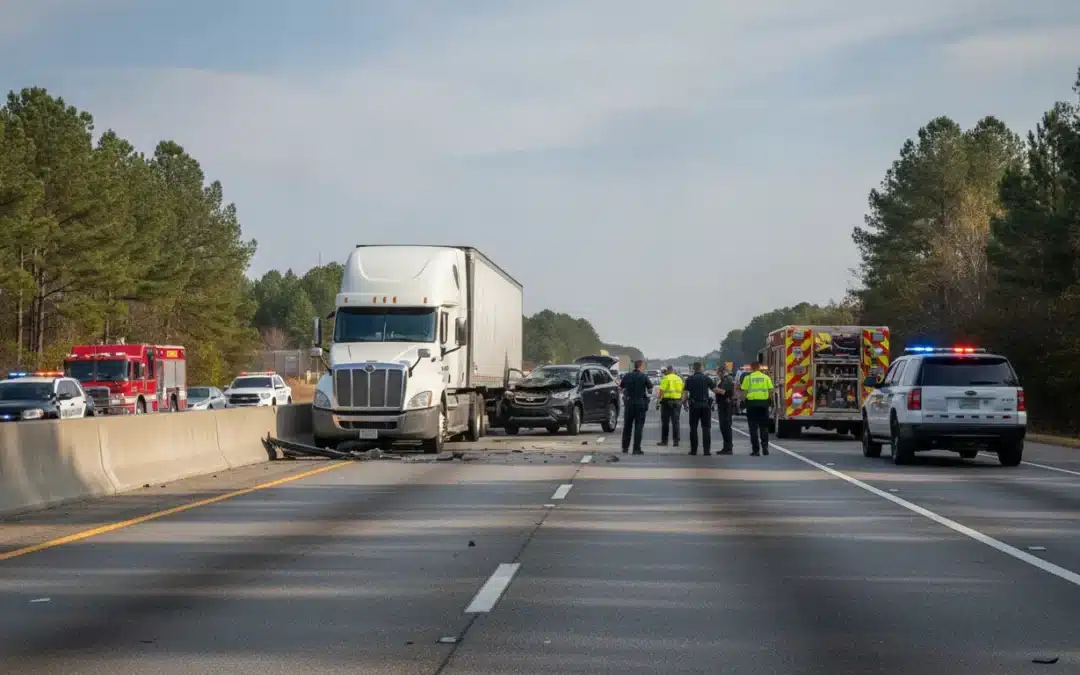
After a serious semi-truck crash in Georgia, the carrier’s name on the trailer does not answer the most important question: who may be responsible? The evidence can be spread across driver conduct, dispatch decisions, hiring and training records, maintenance files, safety history, and the events leading to the collision.
A semi truck accident attorney evaluates carrier responsibility by tracing those facts to the crash and the injuries it caused. Carrier liability is not automatic simply because the company employed or hired the driver. The investigation must show what the carrier knew, required, failed to do, or could have prevented, while also examining other potentially responsible parties.
That process matters in Atlanta, Fulton, DeKalb, Cobb, Gwinnett, and communities across Georgia, particularly when severe injuries create long-term medical and financial needs. A careful review starts by mapping the people and companies involved, then testing each possible source of responsibility against records, witness accounts, and physical evidence.
Call 404-800-3060 for a free consultation
How a Semi Truck Accident Attorney Evaluates Carrier Responsibility in Georgia
A serious truck crash can look straightforward at first, but responsibility often depends on records and relationships that are not visible at the scene. A semi truck accident attorney maps the evidence before reaching conclusions. That review may examine the driver’s conduct, the motor carrier’s practices, ownership, maintenance, training, supervision, dispatch decisions, and the source of any mechanical or roadway problem.
Starting with the carrier’s safety record
Public federal records can provide an initial picture of the company operating the truck. The Federal Motor Carrier Safety Administration’s Company Snapshot may show the carrier’s identification, size, cargo, inspections, out-of-service summary, crash data, and safety rating, if one exists. The FMCSA Safety Measurement System uses roadside inspection and crash data from the prior two years, along with investigation data, to identify motor carriers that may present higher safety risks. A company’s Safety Profile may also contain selected inspection and crash reports, as well as results from reviews or enforcement actions.
These records are leads, not automatic proof that a carrier caused a particular Georgia collision. The investigation must connect a documented practice or condition to the crash and the injuries. A lawyer may compare the records with dispatch communications, driver qualifications, training materials, inspection and maintenance documents, and other evidence specific to the trip.
Separating the possible sources of responsibility
The driver may be central to the analysis, but the driver is not the only possibility. The carrier’s hiring, supervision, training, scheduling, or dispatch practices may require examination. The truck’s registered owner may differ from the motor carrier. A maintenance provider may have performed or failed to perform relevant work. A defective part or vehicle system may raise a manufacturer issue. In some circumstances, the roadway or a government-owned vehicle may also need investigation.
That does not mean every person or company connected to a truck is legally responsible. Carrier liability is not automatic merely because the carrier hired or employed the driver. The evidence must show what happened, who had control over the relevant conduct or equipment, and how that conduct contributed to the collision. For broader context about investigating tractor-trailer injury claims, review the firm’s related guide.
Using Georgia crash records with the broader evidence map
In Georgia, the Georgia Electronic Accident Reporting System, or GEARS, stores state crash reports and supports highway-safety analysis. Those records can be considered alongside photographs, witness accounts, vehicle data, inspection materials, and the carrier’s federal profile. For victims and families in Atlanta, Fulton, DeKalb, Cobb, or Gwinnett County, Georgia trucking accident attorneys can help organize those sources without assuming the answer before the facts are developed.
Which Trucking Records Can Show What Happened?
A serious truck-crash investigation often depends on records created before anyone knew a lawsuit might follow. Those records can help reconstruct where the truck was, what the driver was expected to do, how the carrier managed the trip, and whether the physical evidence supports the accounts given after the collision. No single document automatically establishes carrier responsibility. The evidence must be compared with the crash scene, witness accounts, medical records, and other available information.
| Record or source. | What it may help show. | Why it needs context. |
|---|---|---|
| Driver logs and trip records. | Timing, route, rest, dispatch demands, and possible inconsistencies. | Entries should be compared with electronic and physical evidence. |
| FMCSA carrier records. | Inspections, crashes, enforcement history, and safety information. | A profile does not by itself prove this crash was caused by the carrier. |
| Video, witnesses, and crash reports. | Vehicle movement, impact sequence, road conditions, and observations. | Footage and memories can be incomplete or disappear. |
| Maintenance and repair records. | Inspection, service, mechanical, and equipment issues. | The condition must be connected to the collision and resulting harm. |
Driver and trip records
Driver logs, trip sheets, route schedules, time cards, cargo manifests, and related dispatch materials may help establish the sequence of events. Investigators can compare planned pickup and delivery times with GPS data, toll records, fuel receipts, electronic logging information, and the location and timing of the crash. That comparison may reveal questions about fatigue, scheduling pressure, an unexpected route change, or whether the truck could realistically have completed the assigned trip as described.
These records should be reviewed carefully rather than treated as conclusive. A log entry may not match other electronic or physical evidence, while a delay may have an innocent explanation. The goal is to identify inconsistencies worth investigating and preserve the underlying data before it is overwritten or lost.
Crash reports and carrier safety records
In Georgia, the Georgia Electronic Accident Reporting System, or GEARS, stores the state crash report. The report can provide an important starting point for identifying the vehicles, witnesses, road conditions, and initial observations recorded after the collision. It is evidence to analyze, not necessarily the final word on fault. Georgia’s GEARS crash-report system explains the database’s role in storing state crash reports.
Federal carrier records add a broader view. The Federal Motor Carrier Safety Administration’s Company Snapshot may show a carrier’s identification, size, cargo, inspections, out-of-service summary, crash data, and safety rating, if one exists. The FMCSA Safety Measurement System uses roadside inspection and crash data from the last two years, along with investigation data, to identify higher-risk carriers. A Company Safety Profile can also include selected inspection, crash, review, and enforcement information.
Those profiles do not by themselves prove that a carrier caused a particular Georgia crash. They can, however, help an investigator determine which safety questions deserve closer attention and whether additional records should be requested.
Video, witnesses, maintenance, and dispatch evidence
Surveillance video from nearby businesses, traffic cameras, onboard systems, and residential properties may capture the truck’s speed, lane position, lighting, or movements before impact. Eyewitness interviews and police reports can help test those details. Accident reconstruction may then place the accounts alongside vehicle damage, roadway evidence, and the truck’s physical condition.
Maintenance inspections, repair invoices, parts records, and service schedules may raise separate questions about brakes, tires, steering, loading, or other mechanical conditions. Investigators may also examine whether a defective part, negligent inspection or maintenance, or dangerous road condition contributed to the crash. Dispatch communications and messages can show what instructions were given, when conditions were reported, and how the carrier responded.
For a deeper look at how carrier safety violations may affect an investigation, review the related guide. The right records do not replace a fact-specific legal analysis, but they can show where that analysis needs to go next.
How Do FMCSA Hours-of-Service Rules Affect a Georgia Truck Claim?
Federal hours-of-service rules can help show whether fatigue, scheduling pressure, or an inaccurate duty record played a role in a commercial truck crash. They do not, by themselves, establish that a carrier is legally responsible. A semi truck accident attorney must still connect any violation or record discrepancy to the driver’s conduct, the carrier’s practices, and the cause of the collision.
The basic limits on driving and duty time
For property-carrying drivers, the Federal Motor Carrier Safety Administration generally permits a maximum of 11 hours of driving after 10 consecutive hours off duty. The driver also may not drive beyond the 14th consecutive hour after coming on duty, even if some of that window was spent doing non-driving work. These are separate questions: a driver might reach the 14-hour window before using all 11 driving hours, or reach the driving limit while still inside the window. The FMCSA summary of hours-of-service regulations explains both limits.
The rules also require a 30-minute break after a driver has accumulated eight hours of driving without an interruption of at least 30 minutes. In addition, a driver may not drive after being on duty for 60 hours in seven consecutive days or 70 hours in eight consecutive days. Those cumulative limits can matter when investigators examine several days of logs, dispatch records, and trip timing rather than looking only at the day of the crash.
Why exceptions make the records important
Hours-of-service analysis is not always as simple as counting timestamps. Certain sleeper-berth schedules may split the required 10-hour off-duty period when the periods meet specified minimums, including one period of at least two hours and another with at least seven consecutive hours in the sleeper berth. The FMCSA also allows certain property-carrying drivers to extend the 11-hour driving limit and 14-hour window by up to two hours when adverse driving conditions are encountered.
Those exceptions do not give a carrier a blanket defense. The relevant questions include whether the exception applied, whether the required conditions existed, and whether the driver’s records accurately reflect rest, driving, and on-duty periods. Investigators may compare electronic logging data with fuel receipts, toll records, delivery schedules, phone data, dispatch messages, and witness accounts. A record that appears compliant in isolation may look different when compared with the physical timeline of the trip.
What this means for a Georgia claim
In Georgia, a possible hours-of-service issue is one part of a broader causation investigation. The evidence must help answer whether the driver’s condition or the carrier’s scheduling and supervision contributed to this particular crash and the resulting injuries. A violation that had no connection to the collision is not automatically proof of liability, while a fatigue-related timeline may be significant even when the records require careful interpretation.
Preserve crash reports and other time-sensitive evidence promptly, and do not assume that a carrier’s first account is complete. You can review related information about Georgia truck accident deadlines without relying on an unverified deadline here. A Georgia truck investigation should be tailored to the facts, the available records, and the injuries involved.
When Can a Carrier, Employer, or Other Company Share Responsibility?
A serious truck crash in Georgia may involve more than the person behind the wheel. But identifying a possible source of responsibility is not the same as proving legal liability. A carrier is not automatically responsible simply because it hired or employed the driver. The investigation must connect a company or individual decision to the collision and the injuries that followed.
The driver remains one important focus. Investigators may examine what the driver did before and during the crash, including whether dispatch instructions, route demands, or other work expectations affected the driving conduct. They may also review the motor carrier’s hiring, training, supervision, and safety practices. Questions can include whether the company checked qualifications, provided appropriate instruction, responded to known concerns, or made decisions that contributed to unsafe operation. Those questions call for records and testimony, not assumptions.
A motor carrier may also need to be evaluated separately from the driver. Relevant company practices can include dispatch, scheduling, supervision, and the way safety concerns were handled. The carrier’s maintenance system may matter as well. For example, a truck’s condition, inspection history, repair records, or decisions about taking equipment out of service may help explain whether a mechanical issue played a role. The investigation should connect any maintenance concern to the actual crash rather than treating the existence of a defect as conclusive.
Other entities may belong on the investigation map. Depending on the evidence, that can include a vehicle owner, an outside maintenance provider, or a parts manufacturer. A defective truck or part, negligent inspection or maintenance, or dangerous road conditions may point investigators toward additional causes that require closer examination. A broker or shipper may also need to be identified so the relationships, responsibilities, and communications surrounding the trip are clear. In some circumstances, a government entity may warrant investigation, particularly when the facts involve a government-operated vehicle or another government-related role.
These possibilities should be tested through the evidence: driver and dispatch records, training and supervision materials, maintenance and repair documents, photographs, witness accounts, and crash analysis. The purpose is to determine what happened, who had control over the relevant risk, and whether that conduct caused or contributed to the collision. Georgia families can learn more about this evidence-focused approach from our Georgia trucking accident attorneys.
For an injured person in Atlanta, Fulton, DeKalb, Cobb, Gwinnett, or elsewhere in Georgia, a careful review can help prevent the claim from being narrowed too early to only the driver or only the carrier. It can also prevent unsupported accusations. Each potentially involved party should be pursued only when the evidence supports that path.
What Compensation Can Serious Georgia Truck-Crash Injuries Require?
Serious truck-crash injuries can affect nearly every part of a person’s life. A case evaluation looks beyond the first hospital bill to understand the care, support, income, and independence an injured person may need over time. That assessment is case-specific. There is no reliable settlement range that applies to every Georgia crash, and no attorney can guarantee a particular result.
Medical care and rehabilitation
Potential damages may include emergency treatment, surgery, hospitalization, medication, follow-up appointments, and other current medical expenses. They may also include future care when an injury requires continuing treatment. Rehabilitation can involve physical therapy, occupational therapy, speech therapy, cognitive care, or other services needed to regain function or adapt to a permanent impairment.
These needs may not be fully known immediately after a collision. Medical records, treatment recommendations, and qualified professional opinions can help show what care is reasonably connected to the crash. Schneider Injury Law represents people facing catastrophic injuries, including brain and spinal-cord injuries, paralysis, and amputations. Learn more about working with a catastrophic injury lawyer when a truck crash changes your long-term medical needs.
Income, earning capacity, and daily life
A claim may also address wages lost during recovery and the effect of an injury on future earning capacity. The analysis can involve missed work, reduced hours, a forced career change, or the loss of the ability to perform the same job. Documentation may include employment records, tax information, job duties, and evidence about the person’s experience and future work prospects.
Other potential categories include pain and suffering, disability, loss of independence, and property damage. The impact is not measured only by an injury label. The investigation should consider how the injury affects mobility, relationships, household activities, recreation, and the person’s ability to participate in ordinary life.
When a truck crash causes a death
When a crash is fatal, surviving family members may have different losses to document. Depending on the facts and applicable Georgia law, wrongful-death damages may involve final medical care, funeral and burial costs, lost wages or future income, reduced inheritance, services the person provided, and parental guidance for children.
The severity of the injuries, medical and financial records, future needs, and other case facts all affect valuation. A careful review should establish the losses with evidence rather than rely on a formula or promise.
What Should You Do After a Serious Semi-Truck Crash?
- Get to safety and preserve what you can. If emergency responders are present, follow their instructions and seek immediate help for anyone who is hurt. When it is safe, keep photographs, videos, insurance information, vehicle details, witness names, and other records connected to the collision. Do not assume that the visible scene tells the whole story. A careful investigation may also need surveillance video, eyewitness interviews, police reports, accident reconstruction, and other documents. Those sources can become harder to obtain with time. Surveillance footage may disappear, and witnesses may become more difficult to locate or may remember details less clearly. Review the firm’s Georgia trucking accident guidance for more information about investigating a serious truck crash.
- Obtain the Georgia crash report when it becomes available. Georgia’s Georgia Electronic Accident Reporting System, or GEARS, is the database that stores the state’s crash reports. Keep a copy of the report and note any apparent errors or missing information. The report is an important starting point, but it is not necessarily the final answer about why a semi-truck crash occurred or which parties may share responsibility. A broader review may need to compare the report with photographs, witness accounts, vehicle evidence, and trucking records.
- Follow medical advice and document how the injury affects your life. Attend follow-up appointments, follow prescribed treatment, and tell your providers about new or worsening symptoms. Keep medical records, bills, therapy information, medication details, and notes about missed work or changes in daily activities. Serious truck-crash injuries may develop or become clearer over time, so avoid minimizing symptoms simply because they were not obvious at the scene. Consistent care also helps create a reliable record of what happened after the collision.
- Be careful with statements and quick settlement decisions. You may be contacted by an insurer, carrier, or other representative seeking information about the crash. Before giving a recorded statement, signing a release, or accepting a settlement, consider obtaining legal advice about what the request means and whether it accounts for your ongoing medical needs. Carrier responsibility is fact-specific. It is not automatic merely because a company hired or employed the driver. The relevant questions may include driver conduct, carrier practices, training, supervision, dispatch, maintenance, and other evidence.
- Seek prompt Georgia legal review. Early review can help identify what evidence should be requested and preserved while it is still available. A guide to Georgia truck accident deadlines can provide general information, but deadlines and legal options depend on the facts of the individual case. Schneider Injury Law offers free consultations, with no retainers and no upfront fees. The firm’s approved contingency language is no fee until we win, not a promise of a particular result. Prompt advice is especially important for families in Atlanta and surrounding Fulton, DeKalb, Cobb, and Gwinnett counties managing serious injuries and uncertainty after a crash.
Request a free case evaluation
Frequently Asked Questions
Can I sue after being hit by a semi-truck in Georgia?
You may have a claim against one or more responsible parties, but the answer depends on the evidence. An investigation may examine the driver, motor carrier, truck owner, maintenance provider, parts manufacturer, or another entity. A carrier is not automatically responsible simply because it hired the driver. Responsibility must be connected to the crash, the injuries, and conduct such as unsafe dispatch, inadequate training, negligent supervision, or poor maintenance.
Is the trucking company automatically liable for its driver’s actions?
No. Carrier responsibility is fact-specific. A semi truck accident attorney will typically examine driver conduct, the carrier’s hiring and supervision practices, dispatch decisions, maintenance records, hours-of-service compliance, and the company’s defenses. The investigation may also identify another contributing cause, such as a defective part or dangerous road condition. The available evidence, rather than the employment relationship alone, determines which claims may be appropriate.
What trucking records should be preserved after a Georgia crash?
Important evidence may include the Georgia crash report, driver logs, trip and route records, dispatch communications, inspection and maintenance documents, onboard data, surveillance video, and witness information. The Federal Motor Carrier Safety Administration’s Company Snapshot and Company Safety Profile can also provide selected carrier inspection, crash, review, and enforcement information: FMCSA company safety records. Prompt preservation matters because video may disappear and witnesses’ memories can fade.
How long will a semi-truck accident claim take to resolve?
There is no reliable timeline that applies to every Georgia truck crash. Duration can depend on injury treatment, the amount of evidence, the number of potentially responsible parties, insurance issues, and whether the matter resolves through negotiation or requires litigation. A lawyer should evaluate the facts before estimating next steps, and an early investigation can help preserve evidence while it remains available.
Attorney reviewer: Bethany Schneider, founder and Georgia trial lawyer, brings former defense-side experience and more than 40 trials to serious injury cases. Learn more about Bethany Schneider, trial lawyer.
Disclaimer: This article is for educational purposes only and is not a substitute for legal advice about a specific claim. Every case depends on its facts, evidence, injuries, and applicable law.
Talk With a Georgia Trucking Trial Lawyer
A careful review can help clarify which records, companies, and decisions may matter after a serious Georgia truck crash. Claim your free consultation with Schneider Injury Law. Consultations are free, with no retainers or upfront fees, and no fee UNTIL we win. You can also call 404-800-3060 to discuss what happened and learn about possible next steps without pressure.