

Most trucking cases settle within predictable ranges. But some don’t. Some escalate into high-exposure, multi-million dollar claims. In Georgia trucking litigation, this difference often comes down to two things: nuclear verdict leverage and punitive damages.
Nuclear Verdict Leverage vs. Punitive Damages
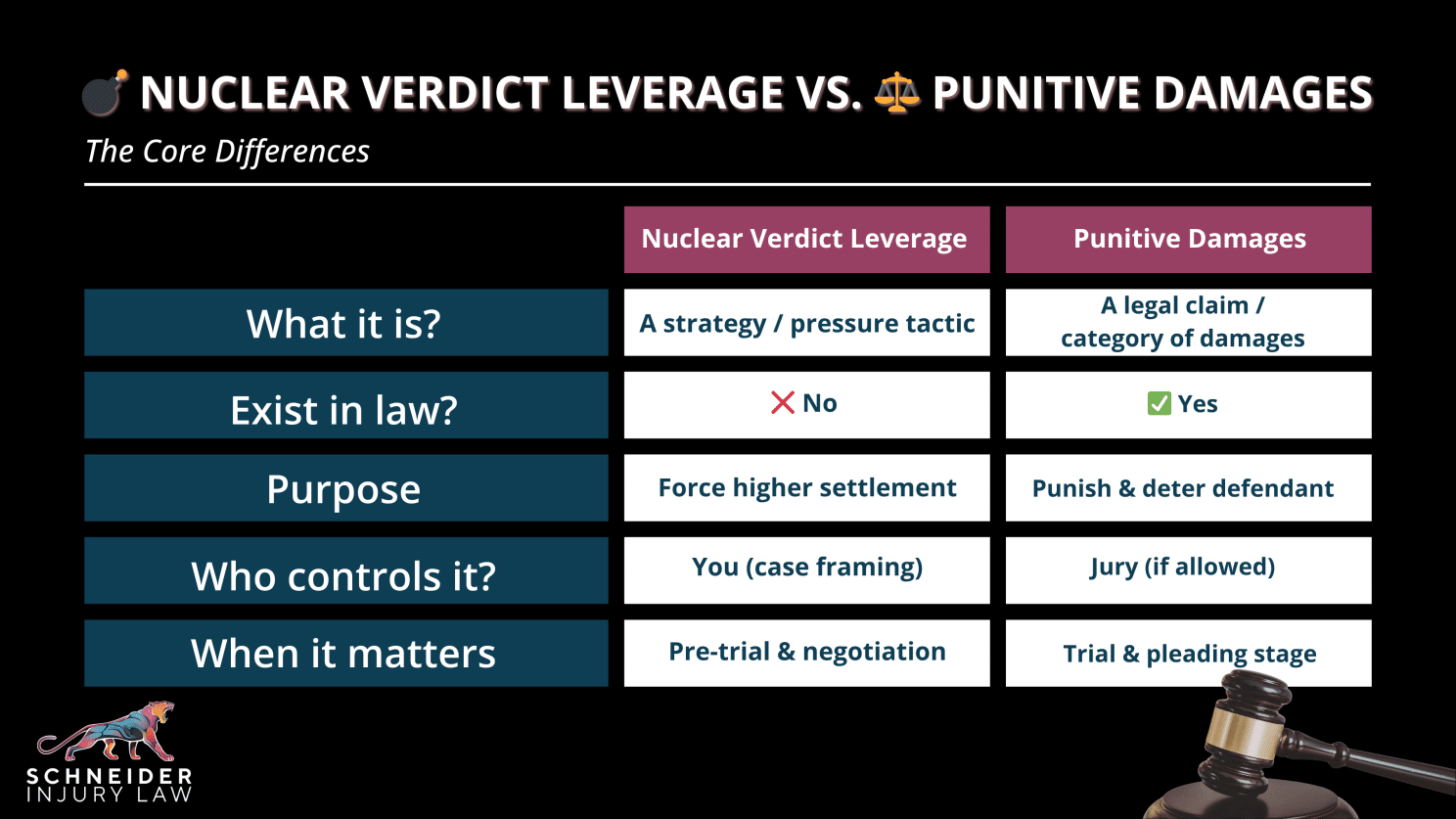
These concepts are often discussed together, but they serve very different roles:
- Punitive damages create legal exposure
- Nuclear verdict leverage turns that exposure into settlement power
Understanding how they interact is critical to evaluating—and maximizing—the value of a commercial trucking case.
What Is Nuclear Verdict Leverage?
A “nuclear verdict” refers to a runaway jury verdict—often reaching millions or even tens of millions—driven by juror outrage, corporate misconduct, and compelling damages.
Nuclear verdict leverage is the ability to use that risk to influence settlement. It is not about what a jury will do—it is about what the defense believes a jury could do.
That perception alone can significantly increase:
- Insurance reserves
- Settlement authority
- Urgency to resolve before trial
Unlike punitive damages, nuclear verdict leverage is not a legal claim—it is a litigation strategy.
Punitive Damages Under Georgia Law
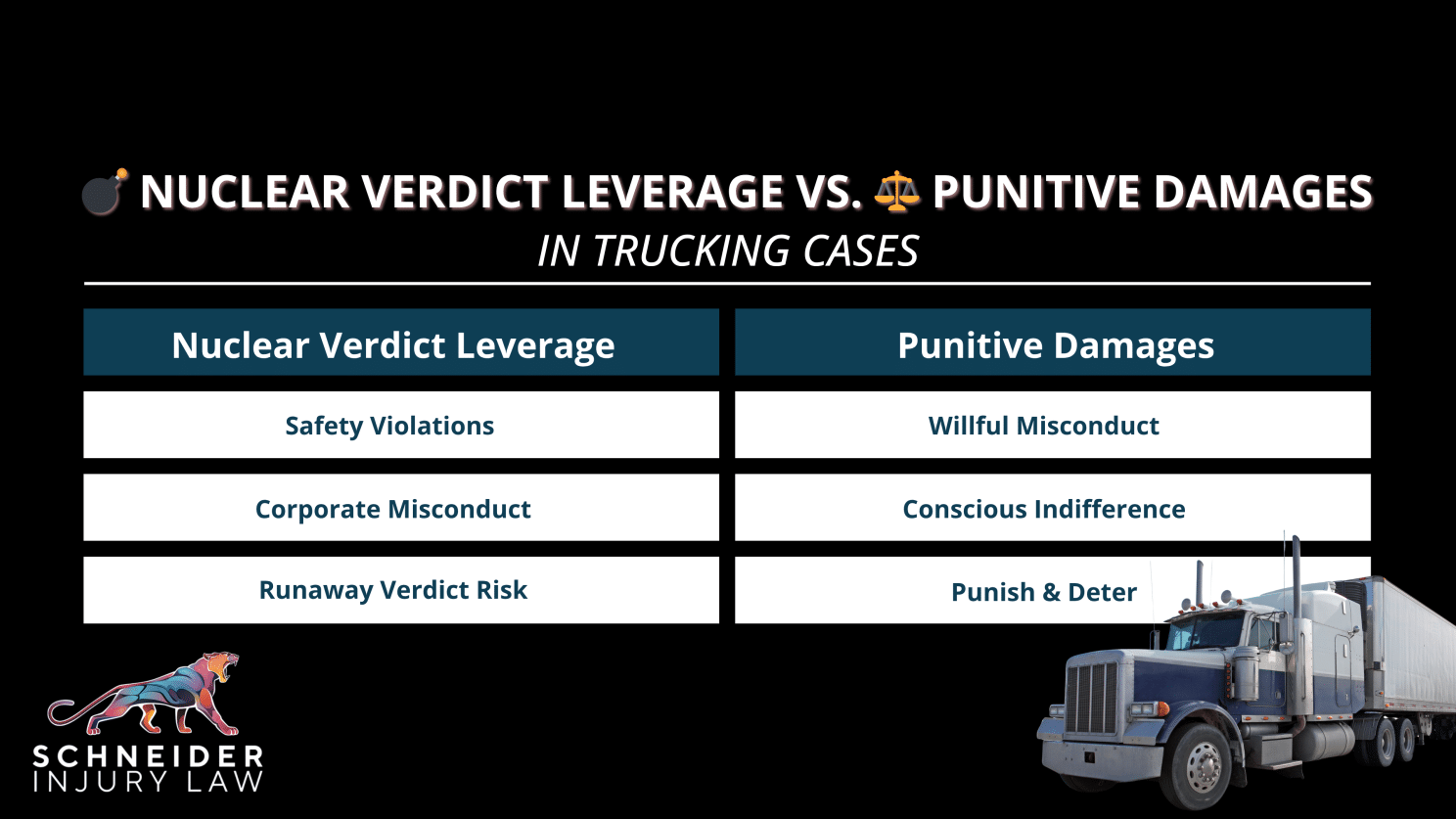
Punitive damages in Georgia are governed by O.C.G.A. § 51-12-5.1 and are intended to punish and deter particularly egregious conduct. To recover punitive damages, a plaintiff must prove more than negligence. The conduct must rise to a level such as:
- Willful misconduct
- Malice
- Fraud
- Wantonness
- Conscious indifference to consequences
In trucking cases, this standard is often met when a driver or motor carrier knowingly violates safety rules designed to protect the public.
Common Scenarios Supporting Punitive Damages
- Repeated Hours-of-Service (HOS) violations
- Allowing an unqualified or unsafe driver to operate
- Ignoring known maintenance defects (brakes, tires, lighting)
- Failing to enforce or monitor compliance with federal safety regulations
Georgia generally caps punitive damages at $250,000, but this cap may not apply in cases involving aggravated conduct, including impaired driving.
How Punitive Damages Create Nuclear Verdict Leverage
When a case includes facts that support punitive damages, it introduces a critical element: unpredictability.
Without punitive exposure, a case is often evaluated within a predictable range based on medical specials, pain and suffering, and lost wages. With punitive exposure, the defense must also account for jury punishment, emotional decision-making, and corporate accountability narratives.
This uncertainty is what drives settlement pressure—and creates leverage.
Building a High-Value Trucking Case
Maximizing value requires intentional case development:
- Identify Regulatory Violations — HOS, maintenance, driver qualification, and compliance failures
- Prove Knowledge — Did the company know about prior violations or risks?
- Show a Pattern — Repeated violations are more powerful than isolated incidents
- Establish Corporate Responsibility — Inadequate training, lack of supervision, unsafe incentives
- Frame the Narrative — “This was not an accident—it was preventable.”
When done effectively, a case transforms from “A crash occurred” to “This outcome was inevitable.”
Why Trucking Cases Are Especially Vulnerable to High-Value Liability
Trucking litigation is uniquely positioned for high-value outcomes because it operates in a heavily regulated safety environment. In Georgia, federal motor carrier safety regulations (FMCSRs) are largely adopted and enforced, creating a clear standard of care.
When these rules are violated, it is not viewed as a simple mistake. It is a breach of known safety obligations—strengthening liability and opening the door to punitive exposure and nuclear verdict leverage.
Key Georgia Trucking Regulations That Drive Liability
Driver Qualification — 49 CFR Part 391
Drivers must be properly licensed (CDL), medically qualified, and competent to operate a commercial vehicle. Failures in this area support negligent hiring and retention claims.
Hours of Service (Fatigue) — 49 CFR Part 395
Federal HOS rules impose strict limits on driver operating time, including an 11-hour driving limit after 10 hours off duty, a 14-hour on-duty window, a 30-minute break requirement, and 60/70-hour weekly caps. Georgia may allow limited intrastate variations.
Inspection & Maintenance — 49 CFR Parts 393 & 396
Required pre-trip, post-trip, and annual inspections are mandatory. Brake failures and tire defects are classic forms of negligence evidence in trucking litigation.
Cargo Securement Rules
Improperly loaded or unbalanced cargo can lead to shifting loads, jackknifes, and rollovers—creating catastrophic consequences on Georgia roadways.
Recordkeeping & Logging (ELDs)
Missing logs, inspection reports, or maintenance records can create spoliation issues that significantly strengthen plaintiff claims.
Insurance & Compliance Requirements
Required coverage varies depending on cargo type and the scope of the trucking operation.
Practical Impact on Settlement
Without nuclear verdict leverage:
- Predictable case valuation
- Limited negotiation range
With nuclear verdict exposure:
- Increased insurance reserves
- Expanded settlement authority
- Strong incentive to resolve before trial
The key question shifts from “What are the damages?” to “What could a jury do with this case?”
Protecting Your Rights After a Trucking Accident
If you or a loved one has been involved in a commercial trucking accident, take these steps immediately:
- Document injuries and medical treatment
- Preserve evidence (photos, witnesses, vehicle damage)
- Avoid speaking with insurance companies before consulting counsel
- Do not accept early settlement offers
These cases are often won or lost in the earliest stages of investigation.
Final Thoughts
The most valuable trucking cases are not defined solely by the severity of injury—but by the story behind the conduct. When evidence shows that a trucking company knew the rules, ignored the risks, or failed to protect the public, the case becomes more than negligence. It becomes a case a jury may want to punish. This is where true leverage begins.
Make the Right Choice — Choose Schneider Injury Law
Experience matters when the stakes are high. Commercial trucking cases are complex, and success depends on attorneys who understand how to investigate, document, and litigate these cases from day one.
If you or a loved one has been injured in a trucking accident, contact Schneider Injury Law to explore your recovery options and ensure your case receives the expert attention it deserves.