
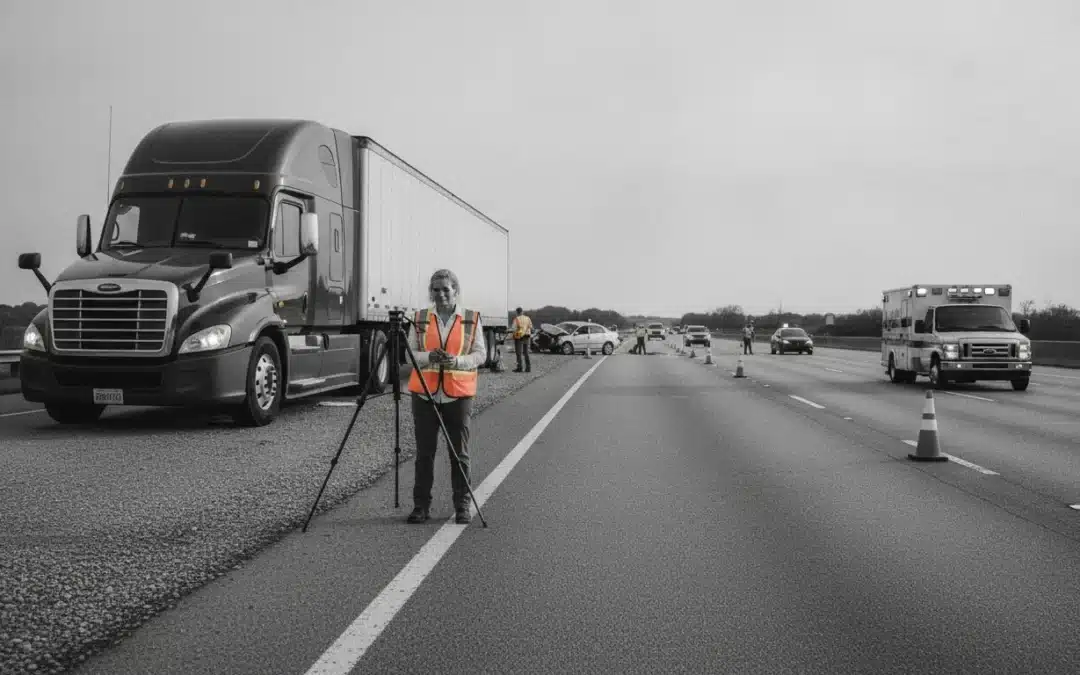
After a Georgia truck crash, the company that arranged the shipment may not be the same company that owned the truck, employed the driver, or carried the insurance. That distinction matters because identifying every potentially responsible party often requires reviewing contracts, communications, safety records, dispatch information, and crash evidence before key details disappear.
Reviewed by Bethany Schneider, trial attorney. Updated October 5, 2026.
A Georgia claim involving a freight broker is not automatic just because the broker arranged transportation. It may be worth investigating when the broker’s conduct, including how it selected or evaluated a motor carrier, is connected to the alleged risk. This guide explains how a freight broker truck accident lawsuit Georgia case may be evaluated. In Montgomery v. Caribe Transport II, LLC, the U.S. Supreme Court held that a negligent-hiring claim against a broker was not preempted by the FAAAA, while leaving the underlying facts and proof to be evaluated. Read the opinion.
A careful review starts with the basic roles in the shipment and the evidence showing what each party knew, did, or controlled. Understanding those roles is the first step toward evaluating whether the broker’s involvement has legal significance.
What Is a Freight Broker, and How Is That Role Different From a Motor Carrier?
A freight broker helps arrange transportation. The broker may connect a shipper with a trucking company, coordinate the shipment, and handle communications or logistics. A motor carrier is the company that provides the transportation itself. In a Supreme Court case involving a broker and a carrier, the broker coordinated the shipment while the motor carrier transported the load. The Court’s opinion explains that distinction.
Other labels can matter, but they do not answer the liability question by themselves:
- Shipper: The business or person sending the goods.
- Freight broker: The intermediary that arranges transportation between the shipper and a carrier.
- Motor carrier: The transportation company responsible for moving the load.
- Driver: The person operating the truck. The driver may be employed by the carrier or may work through another arrangement.
- Owner or lessor: The person or company that owns or leases the truck. That party may be different from the carrier or employer.
- Employer: The entity that employs the driver, if an employment relationship exists.
- Insurer: The company or companies handling coverage and the claim. An insurer is not automatically the same as the party that caused the crash.
In a freight broker truck accident lawsuit Georgia families may consider, the investigation should examine what each party actually did. A broker may have had no role in driving, loading, or supervising the truck. At the same time, the broker’s carrier-selection process, communications, or knowledge of a carrier’s safety history may become relevant to a fact-specific negligent-hiring or negligent-selection theory. In Montgomery v. Caribe Transport II, LLC, the plaintiff alleged that the broker knew or should have known about the carrier’s safety rating and that selecting the carrier created a foreseeable crash risk. That allegation did not establish liability automatically, but it shows why the broker’s conduct may require separate review.
These questions should be analyzed alongside the facts involving the carrier and driver. You can learn more about how to evaluate the motor carrier’s responsibility without assuming that one label resolves the entire claim. For serious crashes involving passenger vehicles as well as commercial trucks, Schneider also provides Atlanta auto accident lawyer guidance.
How a Freight Broker Truck Accident Lawsuit in Georgia May Be Evaluated
A broker’s name in a shipping record does not, by itself, establish responsibility for a Georgia truck crash. The central questions are what the broker did, what it knew or reasonably should have known, and whether those actions were connected to the collision and resulting injuries. A freight broker may have arranged transportation while a separate motor carrier supplied the truck and driver. Those roles must be separated before anyone can assess a claim.
One possible theory is negligent hiring or selection. In Montgomery v. Caribe Transport II, LLC, the injured plaintiff alleged that the broker negligently hired the carrier and driver, including because the broker knew or should have known about the carrier’s safety rating. The theory was that selecting that carrier to transport goods created a foreseeable crash risk. The Supreme Court held that a negligent-hiring claim against a broker was not preempted by the Federal Aviation Administration Authorization Act’s safety exception. The opinion is available from the Cornell Legal Information Institute.
That holding answers a federal preemption question. It does not mean every broker-related claim will succeed, and it does not establish that a broker is liable whenever a carrier it selected causes a wreck.
The case still has to be evaluated under the applicable facts and law. The evidence may need to address the broker’s selection process, available safety information, communications with the carrier, contractual responsibilities, and the relationship between the alleged lapse and the crash.
Arranging transportation is different from negligent conduct
A broker may perform ordinary arranging and coordination services without assuming every duty of the motor carrier. The legal analysis changes if the evidence suggests the broker ignored significant safety information or selected a carrier despite facts that raised a foreseeable risk. It may also change if the broker exercised control in a way that matters to the alleged negligence. Those are fact-specific possibilities, not automatic conclusions. An amici brief filed by Georgia and Nebraska presented the concern that state-law negligence claims could regulate broker services. It also recognized that road-safety regulation and broker tort claims are distinct issues. That policy dispute reinforces why the precise claim and conduct must be identified rather than relying on labels alone.
For an injured person, the practical first step is to identify every participant and preserve the records that show who made which decision. A broker’s involvement may be relevant, but the carrier, driver, owner, employer, shipper, and insurer may also have separate roles and potential defenses. A careful investigation can determine whether the available evidence supports a broker-specific theory or points elsewhere.
What Evidence May Show That a Broker’s Conduct Matters?
A broker’s role may become important when the evidence shows what the broker knew, what it checked, and how it participated in arranging the shipment. The goal is not to assume that arranging transportation creates liability. It is to connect specific broker conduct to the carrier selected, the risks known at the time, and the crash that followed.
Broker selection and safety history
- Broker records and vetting materials: Preserve carrier applications, onboarding forms, qualification files, insurance information, operating authority checks, and any written criteria the broker used to approve the carrier.
- Safety history: Look for safety ratings, inspection and violation records, prior crash information, out-of-service history, and communications discussing the carrier’s safety performance. In Montgomery v. Caribe Transport II, LLC, the plaintiff alleged that the broker knew or should have known of the carrier’s safety rating when it selected the carrier. The Supreme Court’s opinion provides the source for that allegation and its legal context: the Montgomery opinion.
- Contracts and carrier identity: Obtain the broker-carrier agreement, rate confirmations, shipping instructions, bills of lading, load tenders, and records identifying the legal carrier, owner, driver, and insurer. Names on a truck or a phone call may not establish which company accepted responsibility for the load.
- Communications and control: Preserve emails, text messages, portal messages, call logs, and dispatch records showing who selected the route, assigned the load, changed delivery instructions, communicated deadlines, or responded to warnings. These records can help distinguish ordinary brokerage from conduct that may bear on selection, supervision, or control.
- Electronic and physical crash evidence: Request preservation of electronic logging, GPS, dispatch, shipment-platform, camera, and vehicle data before routine deletion. Photographs, scene measurements, vehicle damage, witness information, and police materials can help connect the identified carrier and load to the collision.
- Injury and notice records: Keep medical records, bills, work-loss documentation, and communications with insurers. They document the consequences of the crash while the broker-specific evidence addresses which parties may require further investigation.
Because electronic records and broker files can be overwritten or lost, prompt preservation matters. See this guide to preserving evidence after a truck wreck and this overview of evidence in an 18-wheeler crash. A preservation letter can identify the broker, carrier, shipper, insurer, and electronic systems that may hold relevant information. The evidence still must be evaluated under the facts and applicable law. The Supreme Court has recognized that negligent-hiring claims involve reasonable care in employing a contractor, while transportation policy disputes can involve the Federal Aviation Administration Authorization Act and its safety exception. That legal framework does not replace a careful investigation of what this broker actually did.
What Does Federal Case Law Say About Broker Negligent Hiring?
The U.S. Supreme Court’s May 14, 2026 decision in Montgomery v. Caribe Transport II, LLC addressed an important threshold question for a freight broker truck accident lawsuit in Georgia and elsewhere. The case involved C.H. Robinson Worldwide, a transportation broker that coordinated a shipment, and Caribe Transport II, the motor carrier that transported the load. The injured plaintiff alleged that the broker negligently hired the carrier because it knew, or should have known from the carrier’s safety rating, that selecting it created a foreseeable crash risk.
The district court held that the Federal Aviation Administration Authorization Act, or FAAAA, preempted the negligent-hiring claim, and the Seventh Circuit affirmed. The Supreme Court reversed and remanded. It held that a claim alleging one company negligently hired another to transport goods is not barred by the FAAAA’s transportation provisions. The Court explained that the statute’s safety exception preserves state safety-regulatory authority concerning motor vehicles. Common-law duties and reasonable-care standards can fall within that authority. In the Court’s words, even if the FAAAA otherwise preempted the claim, the safety exception saves it. Read the Cornell text of the Supreme Court opinion.
That holding keeps a broker negligent-hiring theory legally available. It does not establish that every broker is liable after a Georgia crash, decide what evidence proves negligence, or resolve every state-law issue. The facts still matter, including what the broker knew, what it checked, what the carrier’s records showed, and whether the alleged conduct was connected to the injuries.
| Party | Investigation questions |
|---|---|
| Broker | Who selected the carrier? What safety ratings, qualifications, communications, and contracts did the broker review or retain? |
| Motor carrier | What company operated the truck, controlled dispatch, maintained the vehicle, and employed or contracted with the driver? |
| Driver | What training, license, experience, driving history, and hours-of-service information existed before the crash? |
| Shipper | Who arranged the load, supplied cargo information, set delivery requirements, or communicated safety-sensitive instructions? |
| Insurer | Which insurer covers each potentially responsible party, and what claim communications or coverage documents identify those parties? |
Montgomery therefore provides a framework for investigation, not a prediction of the result in a particular Georgia case. A careful review should identify every trucking party and test each possible duty against the evidence.
How Do Georgia Crash Claims Account for Multiple Trucking Parties?
A serious Georgia truck crash may involve more than the driver and the company name printed on the tractor. An investigation can identify the motor carrier operating the load, the driver, the vehicle owner, an employer or staffing company, a freight broker, the shipper, and one or more insurers. Each relationship presents a different question. The fact that a party arranged transportation, owned equipment, or insured a vehicle does not by itself establish legal responsibility. If the collision caused a death, families can also review Schneider’s wrongful death attorney resource while the trucking relationships are investigated.
Start with the operating relationships
Investigators may examine who hired and trained the driver, who controlled dispatch, who maintained the tractor or trailer, and which carrier had responsibility for the trip. They may also review the broker’s role in selecting the carrier, the shipper’s instructions or loading process, and the insurance policies that may apply. These details can help preserve claims against the correct parties while avoiding assumptions based only on a logo, bill of lading, or insurance letter.
For a closer look at one part of this analysis, you can evaluate the motor carrier’s responsibility separately from questions involving a broker or other entities.
A Georgia federal case illustrates why facts matter
In one Georgia federal case, the court described a collision between two tractor-trailers. The driver was operating under dispatch for CTS National Corporation and was hauling an empty tanker trailer. The collision occurred on May 5, 2019, and the court later granted some parts and denied other parts of the defendants’ summary-judgment motions. This is a case-specific example, not a prediction about another crash or a rule that dispatch alone determines liability. The court’s treatment shows why the actual driver, dispatch, equipment, and employment evidence must be developed before conclusions are drawn. Read the Georgia federal decision.
A careful review of the crash report, electronic records, contracts, dispatch materials, maintenance history, and available insurance information can reveal which parties should be investigated and what claims may be supported. It can also prevent a potentially responsible party from being overlooked simply because it was not at the scene.
What Should an Injured Person Do After a Georgia Truck Crash?
After a serious truck collision, practical steps can protect both your health and the information needed to understand who may be responsible. The role of a broker, carrier, driver, shipper, or insurer may not be clear at the scene, so avoid assuming that the first company identified is the only relevant party.
- Get medical care promptly. Call 911 when emergency treatment is needed, follow the recommended care plan, and tell medical providers about every symptom, including pain or limitations that appear later. Keep discharge papers, prescriptions, bills, and appointment records.
- Document the scene and your injuries. If it is safe, take photographs or video of the vehicles, roadway, debris, visible injuries, and surrounding conditions. Save contact information for witnesses and keep copies of the crash report when it becomes available.
- Preserve your personal records. Keep a dated symptom journal and save employer records showing missed work or changed duties. Do not discard damaged clothing, a helmet, child seat, or other physical evidence. More guidance is available on preserving evidence after a truck wreck.
- Identify every trucking entity. Record the names and contact information shown on the truck, trailer, shipping documents, insurance materials, or communications. The motor carrier, driver, vehicle owner, employer, shipper, broker, and insurer may have different roles. A broker’s involvement in arranging transportation does not, by itself, establish liability.
- Protect electronic and broker-related evidence. Relevant information may include dispatch records, contracts, carrier-selection materials, safety-history reviews, driver communications, onboard data, and delivery records. Do not delete texts, emails, voicemails, or photographs. Counsel can help pursue preservation of time-sensitive records, including truck electronic data.
- Be careful with recorded statements. Give accurate information required for the crash investigation, but do not provide a broad recorded statement or sign a release before understanding what it covers. Ask what information is requested and why.
- Seek prompt legal review. A Georgia truck claim can involve fact-dependent filing deadlines and multiple parties. Discuss the matter early so evidence can be preserved and potential claims evaluated. Review Georgia truck accident filing deadlines, because timing depends on the facts and parties involved.
When Should You Discuss a Freight Broker Truck Accident Lawsuit in Georgia?
Consider speaking with counsel when the trucking company, broker, or insurer gives conflicting explanations about who selected the carrier, who controlled the load, or who had access to safety information. A consultation can also be useful when your injuries are serious, the crash investigation is incomplete, or you are being asked to sign a statement or release before the parties and evidence are clear. None of those facts automatically establishes broker liability. They indicate that the relationships and records may warrant a closer review.
Bring the information you have
If possible, bring the crash report, photographs, medical records, insurance letters, contact information for witnesses, and any messages or documents identifying the carrier, broker, shipper, or delivery company. Note what you remember about the truck, trailer, logos, load, and sequence of events. Do not delay medical care while gathering paperwork. Counsel may also need to pursue broker communications, carrier-selection records, contracts, dispatch materials, and other evidence that may not be available to an injured person without legal process.
Questions a consultation can clarify
A lawyer can explain which companies and individuals may need investigation. The available facts may support examining the broker’s selection or oversight conduct, how the motor carrier’s responsibility should be evaluated, and what evidence may be time-sensitive. The analysis depends on the facts, including what the broker knew or reasonably should have known and how that information relates to the crash. A lawyer should also explain risks and uncertainties, not promise a result.
Bethany Schneider leads an Atlanta boutique trial firm and previously defended companies in catastrophic-injury and wrongful-death litigation at King & Spalding. That defense-side insight informs a careful review of how trucking companies, insurers, and other parties may approach a serious claim. Consultations are free, with no retainers or upfront fees. No fee UNTIL we win.
Claim your free consultation or call 404-800-3060.
Frequently Asked Questions
Can you sue a freight broker after a truck accident?
Possibly, but arranging transportation alone does not automatically make a broker liable. The investigation may examine what the broker knew or should have known about the carrier, how the carrier was selected, and whether that conduct was connected to the crash and resulting injuries. The Supreme Court held in Montgomery v. Caribe Transport II, LLC that a negligent-hiring claim against a broker was not preempted by the FAAAA, but that holding does not decide the facts of a Georgia case.
What evidence may show that a freight broker contributed to a Georgia truck crash?
Potentially important evidence includes the broker-carrier contract, messages about selecting or replacing the carrier, carrier safety records, dispatch communications, insurance information, driver qualification materials, electronic logging data, and vehicle event data. Because some records can be overwritten or lost, prompt preservation may matter. Photographs, medical records, witness information, and the crash report may also help establish what happened and who was involved.
What if the truck was owned by one company but the driver worked for another?
That arrangement is not unusual in commercial trucking, and company labels may not answer the responsibility question. Lease agreements, operating-authority records, employment or contractor documents, dispatch records, maintenance records, and evidence of who controlled the work can help identify the owner, carrier, employer, broker, and potentially involved insurers.
Can I make a claim if the trucker was an independent contractor?
Independent-contractor status does not end the analysis. The relevant questions may include who selected the driver, who controlled the work, which company held operating responsibility, and whether any party negligently hired, retained, supervised, or dispatched the driver. The answer depends on the actual relationships and evidence, not one label in a contract.
How long do I have to file a lawsuit after a Georgia truck crash?
The deadline depends on the claims, parties, and circumstances. Claims involving a government entity may involve separate notice requirements, and evidence-preservation needs can arise much sooner than a filing deadline. A prompt review can help identify the responsible parties, protect time-sensitive records, and determine which deadlines may apply to the specific case.
Ready to Discuss Your Georgia Truck Crash?
A focused review can help clarify which parties may warrant investigation, what evidence should be preserved, and how broker conduct fits into the larger claim. Learn more about Schneider’s trucking accident practice, then claim your free consultation with Schneider Injury Law to discuss what happened. Consultations are free, with no retainers or upfront fees. No fee UNTIL we win.